
The estimated reading time for this post is 195 seconds
Technology shares extended their slide as traders weighed the sustainability of AI spending against a pivotal Federal Reserve decision and earnings from Microsoft, Meta, Apple, and Amazon.
Published July 29, 2026 • 5 min read • Federal Finance Journal
◆ INVESTORS SHIFT INTO RISK-OFF MODE
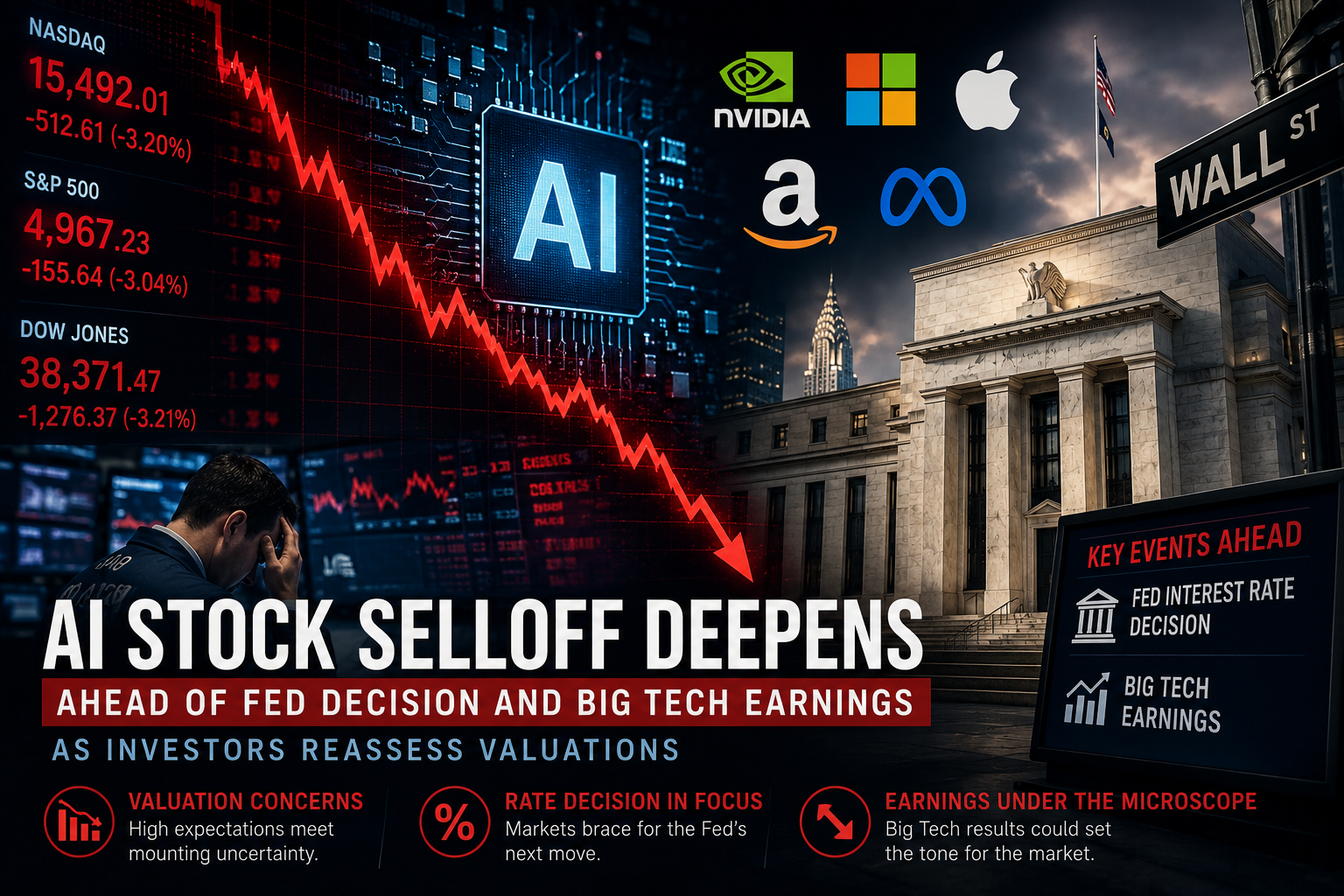
AI Stock Selloff deepened Wednesday as investors reduced exposure to technology shares ahead of the Federal Reserve’s policy decision and quarterly earnings from major technology companies.
Selling pressure was most visible across semiconductor manufacturers, cloud-computing providers, and AI software companies, reflecting growing skepticism that years of aggressive spending on artificial intelligence can continue supporting current market valuations.
The cautious tone comes as the Federal Reserve prepares to announce its latest interest-rate decision while Microsoft, Meta Platforms, Apple, and Amazon are scheduled to report quarterly earnings that could reshape expectations for technology spending during the second half of the year.
Rather than abandoning AI altogether, institutional investors appear to be rotating toward companies with stronger cash flow, predictable earnings, and clearer paths to monetizing artificial intelligence investments.
◆ WHY AI VALUATIONS ARE FACING A REALITY CHECK
Artificial intelligence has been the defining investment theme of the past two years, adding trillions of dollars in market value to leading technology companies and fueling record demand for AI chips, cloud infrastructure, and enterprise software.
That enthusiasm is now meeting a higher bar.
Portfolio managers increasingly argue that markets have already priced in years of optimistic growth, leaving little room for disappointment if revenue fails to keep pace with unprecedented capital spending.
Investors are no longer rewarding companies simply for announcing larger AI budgets. Instead, they want evidence that those investments are generating measurable returns through higher productivity, stronger cloud demand, or expanding profit margins.
◆ THE FEDERAL RESERVE REMAINS THE WEEK’S BIGGEST CATALYST
While corporate earnings dominate headlines, the Federal Reserve remains the market’s primary catalyst.
Economists broadly expect policymakers to leave benchmark interest rates unchanged, but investors will closely analyze Chair Jerome Powell’s comments for signals on inflation, labor-market conditions, and the likelihood of policy easing later this year.
Any indication that inflation continues to moderate could revive demand for growth stocks, while a more cautious message may reinforce the recent shift toward defensive sectors.
Treasury yields, the U.S. dollar, and technology shares are all expected to react quickly to changes in the Fed’s outlook.
◆ BIG TECH EARNINGS COULD RESET THE AI NARRATIVE
Attention will quickly shift from Washington to Silicon Valley as Microsoft, Meta Platforms, Apple, and Amazon release quarterly results.
Together, the four companies represent a substantial share of the S&P 500’s market capitalization and remain among the largest investors in artificial intelligence infrastructure.
Beyond headline earnings, investors will focus on management commentary regarding AI-related capital expenditures, cloud-computing demand, digital advertising, enterprise software spending, and consumer activity.
Strong guidance could reassure investors that AI investment remains economically justified, while weaker forecasts may intensify the recent pullback across technology shares.
◆ WHAT INVESTORS WILL WATCH NEXT
With monetary policy and corporate earnings converging in the same week, market participants expect volatility to remain elevated.
The central question is no longer whether artificial intelligence will transform the global economy, but whether the pace of investment can continue producing earnings growth that justifies today’s premium valuations.
Until the Federal Reserve provides greater policy clarity and major technology companies demonstrate tangible returns on their AI spending, investors are likely to remain selective, favoring quality businesses with resilient cash flows over companies whose valuations rely primarily on long-term expectations.
Market participants expect volatility to remain elevated until both the Federal Reserve’s policy outlook and major technology earnings become clearer. While the current AI Stock Selloff reflects growing caution over valuations, many long-term investors continue to view artificial intelligence as one of the most significant structural growth opportunities of the decade. The coming days could determine whether this pullback becomes a temporary correction or the beginning of a broader sector rotation.