
The estimated reading time for this post is 285 seconds
Choosing a business structure is one of the first major decisions for entrepreneurs in the United States. For many founders, the choice comes down to an LLC vs corporation.
Both structures can provide liability protection, but they differ in ownership, taxation, management, fundraising and compliance. The U.S. Small Business Administration notes that business structure can affect taxes, personal liability, fundraising and required paperwork.
Here are seven key differences business owners should understand before forming a company.
1. Ownership Structure
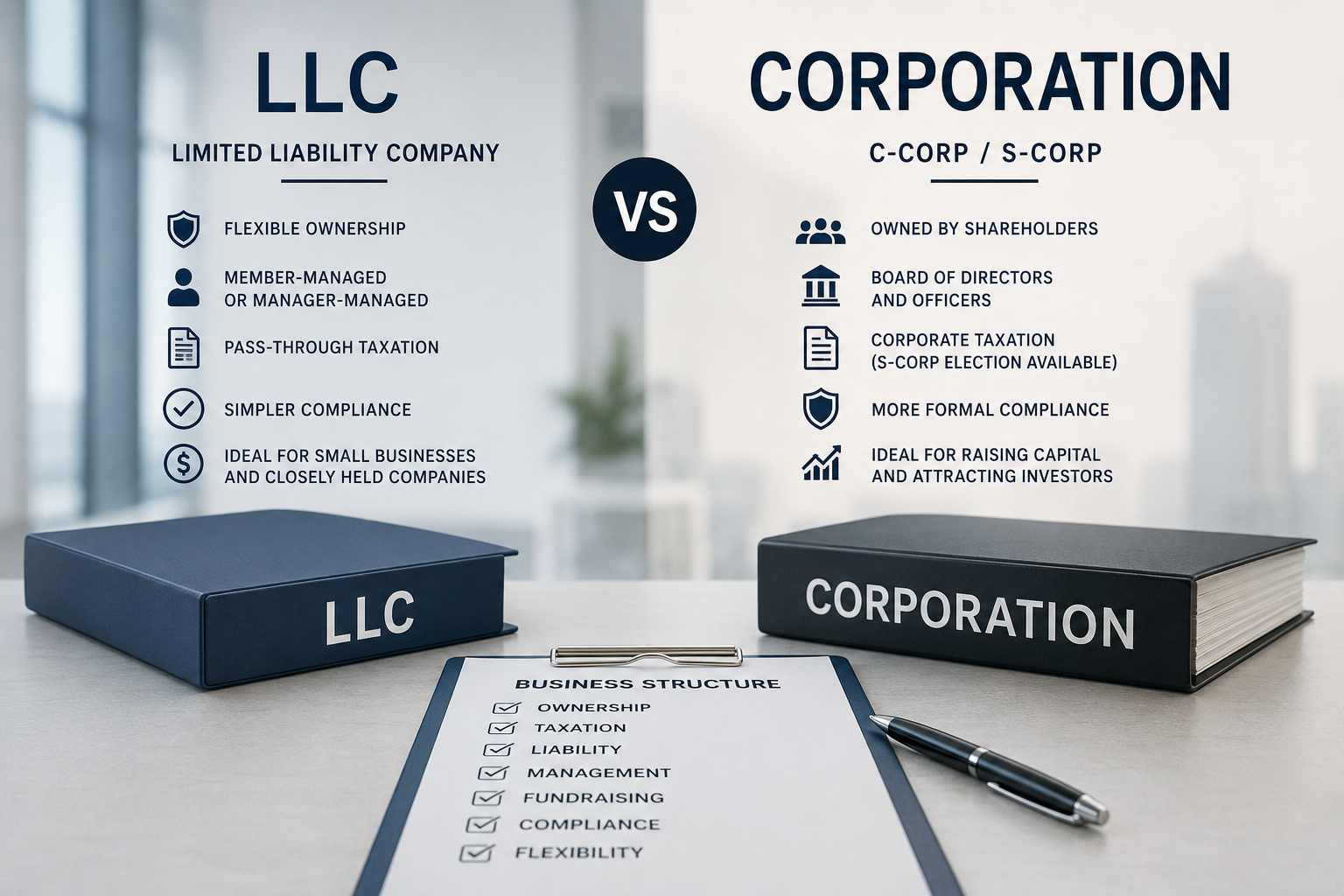
An LLC is generally owned by members, while a corporation is owned by shareholders who hold shares of stock.
LLCs can provide considerable flexibility in how ownership interests, voting rights and profit distributions are arranged. These details are generally established through an operating agreement and applicable state law.
Corporations use shares to represent ownership, creating a more standardized structure for investors.
For a small business with a few owners, an LLC may offer useful flexibility. A company expecting substantial outside investment may find a corporation more suitable.
2. Management and Governance
Management is another important difference in the LLC vs corporation comparison.
An LLC can generally be member-managed or manager-managed. Its operating agreement can establish how decisions are made and who has authority to operate the business.
Corporations normally have a more formal structure involving shareholders, a board of directors and corporate officers.
This can create additional record-keeping and governance responsibilities, but the formal structure may be useful for businesses with multiple investors.
3. Tax Treatment
Taxation is one of the most important areas to understand when comparing an LLC vs corporation.
An LLC does not automatically have one federal tax classification.
According to the IRS, a domestic LLC with one member is generally treated as a disregarded entity for federal income tax purposes unless it elects corporate treatment. A domestic LLC with two or more members is generally treated as a partnership unless it elects to be taxed as a corporation.
A corporation follows corporate tax rules, although eligible corporations may elect S corporation status.
Because state and federal tax rules can differ, entrepreneurs should not choose a structure based solely on perceived tax savings. Professional tax advice may be appropriate before making the decision.
4. Liability Protection
Both LLCs and corporations are designed to create legal separation between the business and its owners.
This separation can help protect personal assets from certain business debts and claims. However, forming an entity does not eliminate every form of personal liability.
Owners should maintain appropriate records, follow applicable laws and keep personal and business finances properly separated.
The SBA identifies both LLCs and corporations as structures that can provide personal liability protection.
5. Raising Capital
Fundraising can strongly influence the LLC vs corporation decision.
Corporations generally have an advantage when a business expects to raise significant equity capital because they can issue shares of stock.
This familiar structure can make it easier to accommodate multiple investors and different ownership interests.
LLCs can also have multiple owners and customized ownership arrangements. However, a startup planning to seek institutional investment may find a corporation more aligned with investor expectations.
For a founder-funded small business, an LLC’s flexibility may be more important than a standardized stock structure.
6. Compliance Requirements
Neither an LLC nor a corporation is completely maintenance-free.
Depending on the state and business activities, owners may need to file annual reports, pay state fees, maintain licenses, meet tax obligations and keep appropriate company records.
Corporations generally have more formal governance and record-keeping requirements. LLCs often have greater flexibility, although their owners still need to follow state requirements and maintain proper documentation.
The SBA recommends considering paperwork and ongoing obligations when selecting a business structure.
7. Formation Is Only the Beginning
Creating an LLC or corporation is only the start of operating a U.S. business.
After formation, owners may need an Employer Identification Number (EIN), licenses, permits, business banking and ongoing compliance procedures. The IRS provides information about EIN requirements and applications.
For entrepreneurs who prefer assistance with the administrative side of establishing a U.S. company, a business formation service may be worth evaluating.
Before choosing a provider, compare formation fees, registered-agent services, annual renewal costs, state coverage and what is actually included in the package.
For international entrepreneurs, additional U.S. tax and reporting considerations may also apply. Forming a U.S. company does not automatically determine how an owner will be taxed in another country.
LLC vs Corporation: Which Is Better?
There is no universal winner in the LLC vs corporation debate.
An LLC may be attractive to owners who prioritize flexibility and customized management. A corporation may be more appropriate for businesses that expect substantial outside investment or want a conventional share-based ownership structure.
The decision should consider:
- Ownership and future investors
- Federal and state tax treatment
- Liability protection
- Management structure
- Fundraising plans
- Ongoing compliance costs
Business owners should also remember that changing a business structure later can create tax consequences and other complications depending on the circumstances.
Read more: 7 Essential Steps to Start a U.S. Business as a Nonresident
Final Takeaway
The LLC vs corporation decision can affect how a business is owned, taxed, managed and financed.
An LLC may offer greater flexibility for many small businesses, while a corporation can provide a more standardized structure for companies seeking outside equity investment.
Before filing formation documents, entrepreneurs should review state requirements and federal tax rules and consider their long-term business plans.
For international founders, professional advice can be particularly valuable because U.S. business formation may interact with tax and reporting obligations outside the United States.