The estimated reading time for this post is 410 seconds
Rolling Forecasts vs Annual Budgets is an increasingly important discussion for corporate finance teams. Both approaches can help companies plan resources, evaluate performance, and prepare for changing business conditions, but they serve different purposes.
For decades, the annual budget has been one of the most important planning tools in corporate finance. Finance teams typically spend months building revenue targets, expense plans, hiring assumptions, capital expenditure budgets, and cash-flow projections for the coming year.
The problem is that business conditions rarely follow the calendar.
Customer demand can change. Costs can rise. Interest rates can move. A new product may outperform expectations, while another may require a major adjustment. By the middle of the year, some assumptions in the original budget may no longer reflect the business.
That is where rolling forecasts can play an important role.
Rather than replacing the annual budget completely, a rolling forecast gives finance teams a way to regularly update their expectations as new information becomes available.
What Is an Annual Budget?
An annual budget is a financial plan covering a defined fiscal year.
It usually includes expected revenue, operating expenses, headcount, capital expenditures, cash requirements, and other financial targets.
The budgeting process provides structure. Department leaders understand what has been approved, while executives and boards have a common framework for evaluating performance.
Annual budgets can also help companies allocate resources before the year begins.
But there is an important limitation: a budget is based on assumptions available when it was created.
If those assumptions change significantly, the original budget may still be useful as a target, but it may no longer represent the company’s best estimate of what will happen next.
What Is a Rolling Forecast?
A rolling forecast continuously updates the company’s financial outlook.
Instead of forecasting only until the end of the current fiscal year, finance maintains a defined forward-looking period.
For example, a company might maintain a five-quarter forecast. When one quarter ends, that period is replaced by a new quarter at the end of the forecast.
The process can be updated monthly or quarterly, depending on the company’s needs.
The goal is not to predict the future perfectly. It is to keep the financial outlook connected to the latest available information.
The Association for Financial Professionals has highlighted rolling forecasts as an approach that can help FP&A teams maintain a more forward-looking planning process.
Why Use a Rolling Forecast?
- It Keeps Financial Expectations Current
Revenue and expense assumptions can change throughout the year.
A company may see weaker-than-expected sales, higher supplier costs, or stronger demand for a particular product. Updating the forecast allows management to incorporate those developments rather than relying entirely on assumptions made months earlier.
- It Supports Better Resource Decisions
A current forecast can help management evaluate practical questions:
Should hiring plans change?
Is additional working capital required?
Can planned capital expenditures still be funded?
Should discretionary spending be delayed?
Is there room to increase investment in a growing business area?
The forecast does not make these decisions. It provides management with a more current financial picture.
- It Can Focus Finance on Business Drivers
Traditional budgets can involve thousands of individual line items.
Rolling forecasts can instead focus on the operational factors that have the greatest influence on financial performance.
A software company, for example, may focus on new customers, retention, average revenue per customer, sales pipeline, and headcount.
A manufacturer may pay closer attention to production volume, raw material costs, labor hours, inventory, and selling prices.
This driver-based approach can make forecasts easier to update and discuss with business leaders.
Rolling Forecasts vs Annual Budgets
The two approaches are not necessarily competing systems.
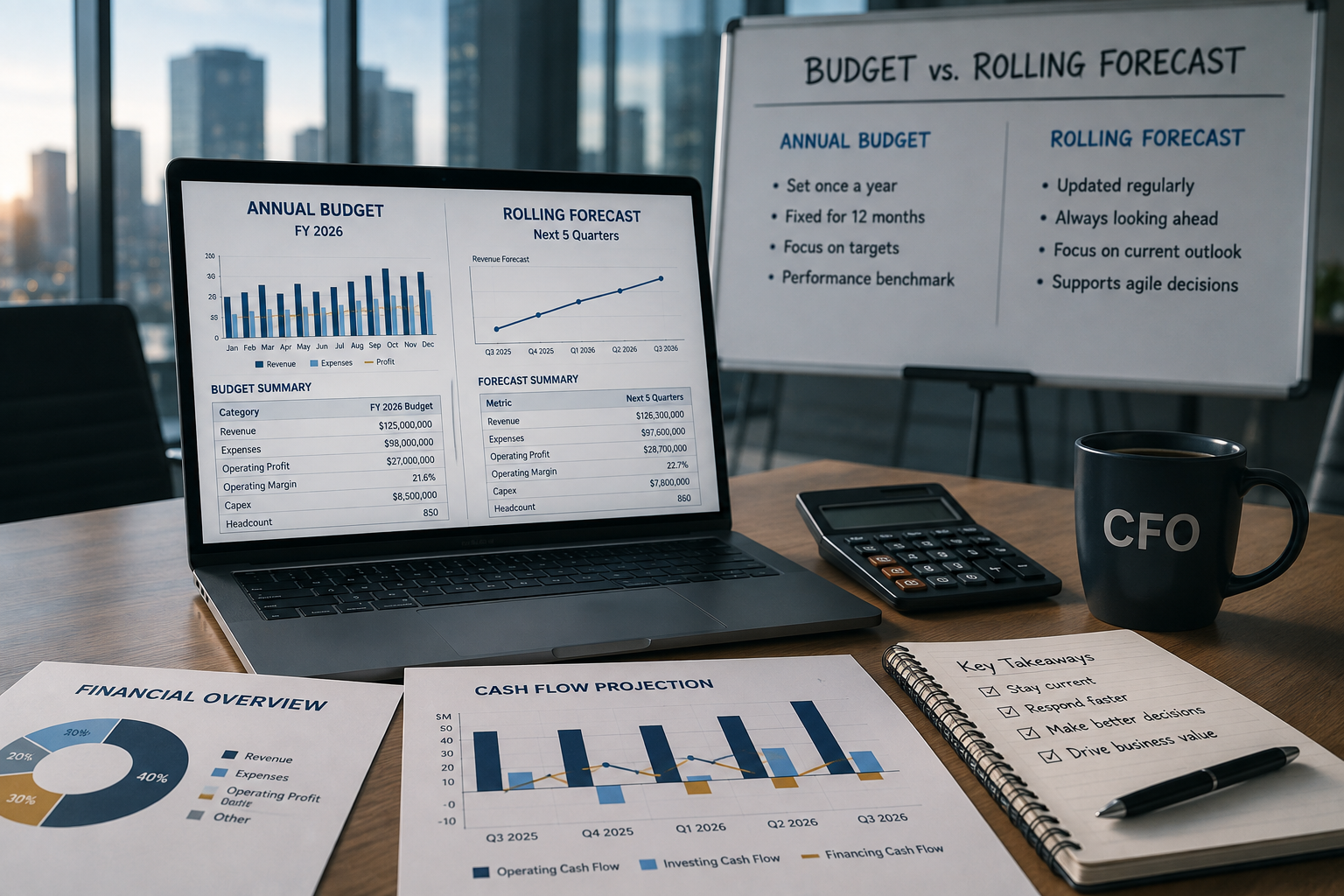
| Annual Budget | Rolling Forecast |
| Usually prepared once per fiscal year | Updated regularly |
| Establishes an approved plan | Provides a current outlook |
| Useful for targets and accountability | Useful for operational decisions |
| Based on assumptions at planning time | Incorporates newer information |
| Generally fixed for the fiscal year | Continuously extends forward |
This distinction is important.
A company does not necessarily need to eliminate its annual budget when it introduces a rolling forecast.
Instead, the two can serve different purposes.
The Hybrid Approach
A practical approach for many finance teams is to use both.
A practical approach for many finance teams is to use both.
Rolling Forecasts vs Annual Budgets does not have to be an either-or decision. It can be used for targets, resource allocation, and performance measurement.
The rolling forecast provides an updated view of expected performance.
Consider a company that approves its 2026 budget in late 2025.
The budget can remain unchanged throughout the year so management can compare actual performance with the original plan.
At the same time, finance can maintain a rolling five-quarter forecast.
After the first quarter, actual results are incorporated and another quarter is added to the end of the forecast. The same process continues throughout the year.
This creates two useful perspectives:
Budget: What did we originally plan?
Forecast: What do we now expect?
Keeping those questions separate can make financial discussions more useful.
The Data Challenge
Rolling forecasts require reliable and timely information.
Finance teams may need data from accounting, sales, operations, payroll, procurement, and other parts of the organization. If that information is delayed or inconsistent, updating the forecast becomes more difficult.
This remains a significant challenge for FP&A teams.
The 2025 AFP FP&A Benchmarking Survey found that 61% of respondents identified unreliable data as a technology challenge, while 60% cited difficulty accessing data. The survey also found that spreadsheets remain widely used in planning and reporting.
Technology can help, but software alone does not solve the problem.
Companies also need clear ownership of the forecasting process, consistent definitions for key metrics, and reliable data flows between departments.
How to Start
Companies do not necessarily need to redesign their entire planning process overnight.
A finance team can start with a few areas that have the greatest impact on the business.
Start with revenue and cash flow. These are often among the most important areas to monitor when conditions change.
Choose a manageable horizon. A five-quarter forecast is one possible starting point, but the appropriate period depends on the company’s business model.
Focus on key drivers. Instead of manually updating every line item, identify the operational factors that have the greatest impact on financial performance.
Establish a clear process. Determine who provides the data, who reviews assumptions, how often the forecast is updated, and how changes are communicated.
Most importantly, keep the role of the budget separate from the role of the forecast.
If the budget changes every time the forecast changes, management can lose the ability to distinguish between the original plan and the latest outlook.
Read more: 7 Corporate Tax Mistakes Costing Small Businesses Thousands in 2026
The Bottom Line
Annual budgets are unlikely to disappear.
They remain useful for setting goals, allocating resources, measuring performance, and establishing financial expectations for the year ahead.
But a budget created months ago does not necessarily represent the best estimate of what will happen next.
That is where a rolling forecast can add value.
For CFOs and FP&A teams, the question may not be whether to choose rolling forecasts vs. annual budgets.
Instead, it may be about understanding what each tool is designed to accomplish.
The annual budget provides structure and accountability. The rolling forecast provides a more current view of where the business may be heading.
Used together, they can give management both a stable financial plan and a clearer view of changing conditions.
Sources
The Association for Financial Professionals has highlighted rolling forecasts as an approach that can help FP&A teams maintain a more forward-looking planning process. AFP Guide to Implementing a Rolling Forecast
The 2025 AFP FP&A Benchmarking Survey found that 61% of respondents identified unreliable data as a technology challenge, while 60% cited difficulty accessing data. 2025 AFP FP&A Benchmarking Survey
This driver-based approach can make forecasts easier to update and discuss with business leaders. AFP Guide to Driver-Based Models and Plans
Editorial note: This article is intended for general informational purposes and does not constitute financial, accounting, tax, or investment advice.
Looking to establish a business in the United States?
If you’re considering forming a U.S. company, you can learn more about company formation services through Zenind.