
The estimated reading time for this post is 362 seconds
Artificial intelligence is becoming a practical tool in corporate finance. Finance teams are using generative AI to summarize documents, analyze data, draft management reports and speed up repetitive accounting tasks. But as adoption grows, one risk deserves particular attention: AI hallucinations in financial reports.
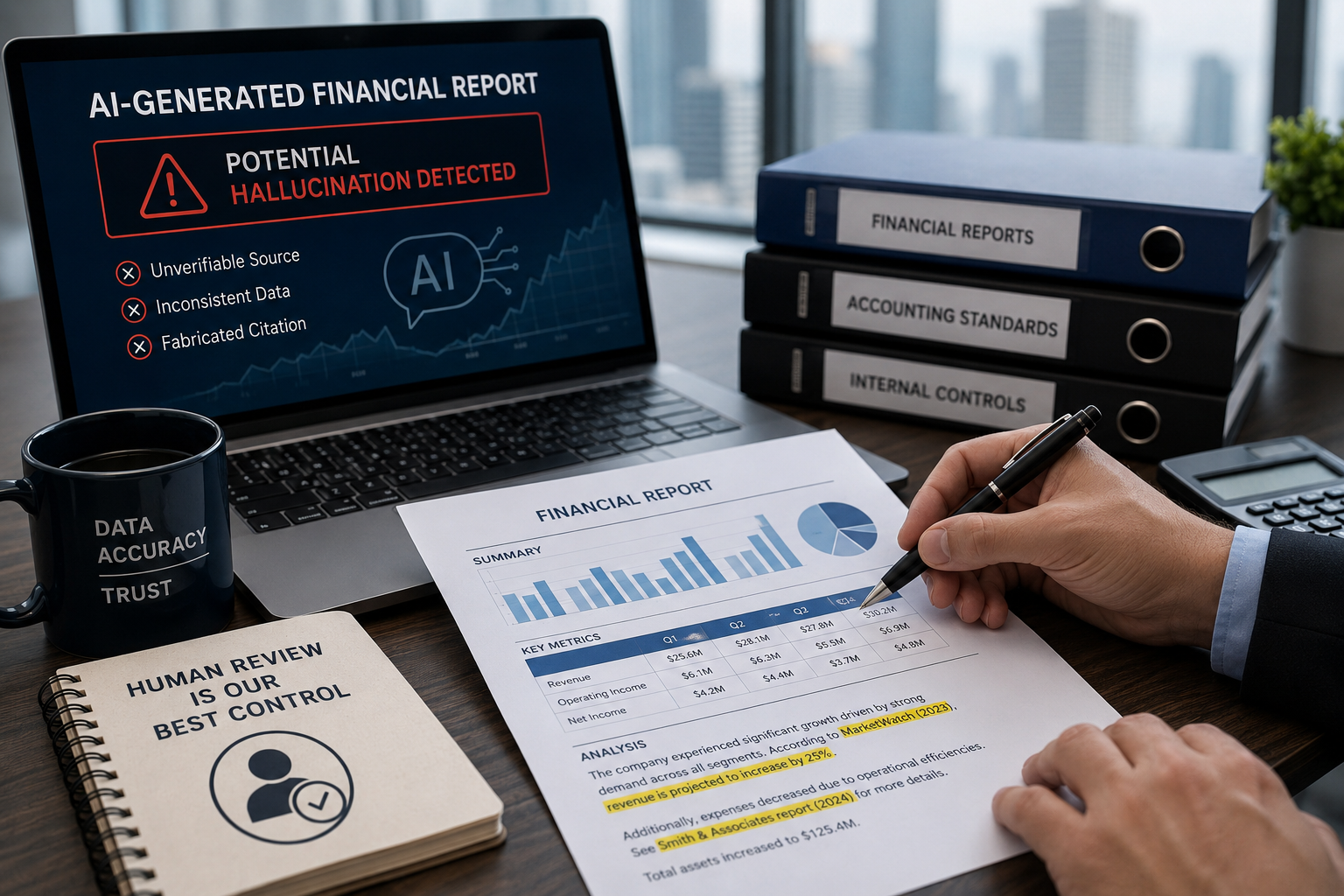
An AI hallucination occurs when a generative AI system produces information that sounds credible but is inaccurate, unsupported or entirely fabricated. As companies adopt generative AI across finance departments, AI hallucinations in financial reports have become an important concern for accounting teams and finance leaders. In a financial environment, that problem can be more serious than a simple writing error. A wrong number, invented source or misleading explanation can affect management decisions, disclosures and investor communications.
The technology can accelerate financial reporting, but it does not eliminate the need for professional judgment. In fact, the more AI becomes embedded in finance workflows, the more important human review may become.
What Are AI Hallucinations in Financial Reports?
Generative AI systems predict and generate text based on patterns in their training and input data. They are not financial databases that automatically understand whether every statement they produce is true.
That distinction matters.
An AI tool might correctly summarize a quarterly report in one instance and then incorrectly attribute a figure, misinterpret an accounting policy or generate a citation that does not support its conclusion in another.
The National Institute of Standards and Technology (NIST) has noted that large language models can struggle to produce long-form reports that are complete, accurate and verifiable.
For finance professionals, verification therefore cannot be treated as an optional final step.
Why Financial Reporting Creates a Higher Risk
Financial reports contain information that must be precise, traceable and consistent.
Consider a typical reporting workflow. An AI system could be asked to summarize revenue trends, explain changes in operating expenses or draft a management discussion based on internal data. If the underlying information is incomplete or the model misinterprets the data, the resulting narrative may appear professional while still being wrong.
The problem is not limited to numerical errors. AI hallucinations in financial reports can also affect how financial information is interpreted, especially when generated explanations are presented without sufficient verification.
AI can also:
- Misinterpret accounting terminology
- Attribute information to the wrong source
- Combine facts from different reporting periods
- Invent explanations for unexpected changes
- Omit important qualifications or assumptions
- Present uncertain information with excessive confidence
The Public Company Accounting Oversight Board (PCAOB) specifically identified the possibility that generative AI could create false or misleading content, commonly referred to as hallucinations. Its 2024 outreach also emphasized the importance of auditability and human supervision when AI is used in auditing and financial reporting.
Human Review Is a Control, Not a Bottleneck
The strongest argument for human review is not that AI is inherently unreliable. It is that financial reporting requires accountability.
A finance professional can ask questions that a generative AI system may not reliably answer on its own:
Does this number reconcile to the source system?
Does the explanation match the underlying transaction?
Is this accounting treatment consistent with company policy and applicable standards?
Does the disclosure provide the necessary context?
These questions require professional skepticism and an understanding of the business.
PCAOB guidance and commentary increasingly emphasize the importance of maintaining human oversight as AI tools become more common in audit and financial reporting environments.
Human review, therefore, should not be viewed simply as someone proofreading AI-generated text. It should be a control designed to verify the accuracy, relevance and support behind the output.
Where AI Can Help Finance Teams Safely
That does not mean finance departments should avoid generative AI.
Used appropriately, AI can help teams handle repetitive work more efficiently. Possible applications include creating first drafts, summarizing lengthy documents, organizing information, identifying unusual items for further investigation and assisting with internal analysis.
The key is to separate AI assistance from final financial judgment.
For example, a finance team could use AI to create a preliminary explanation of why operating expenses changed during a quarter. A finance professional would then compare the explanation against the general ledger, supporting schedules and management records before using any portion of it in a formal report.
This approach allows AI to improve productivity without allowing an unverified output to become an authoritative financial statement.

A Practical Review Process for AI-Generated Reports
Companies using AI in financial reporting can establish a simple review framework.
1. Verify every material number.
AI-generated figures should be checked against authoritative accounting systems, spreadsheets or source documents.
2. Trace important claims to evidence.
If an AI-generated statement cannot be supported by a reliable source, it should not automatically appear in a financial report.
3. Review accounting context.
Numbers can be technically correct while their interpretation is wrong. Finance professionals should examine the underlying transaction and accounting treatment.
4. Check the reporting period.
AI can unintentionally combine information from different periods or documents. Dates and comparative figures deserve particular attention.
5. Document the review.
Organizations should maintain appropriate records showing how AI-generated content was reviewed, corrected and approved.
This type of control environment aligns with the broader emphasis on governance and internal control surrounding emerging technologies. COSO, for example, published “Achieving Effective Internal Control Over Generative AI” as new guidance addressing internal control considerations for generative AI.
Read more: Choosing an AI Bookkeeping Tool: A Buyer’s Checklist for Finance Leaders
The Future of AI in Financial Reporting
AI is likely to become more deeply integrated into finance departments, but its role is more likely to evolve toward augmentation than unrestricted automation.
Finance leaders can use AI to reduce repetitive work and help employees process information faster. At the same time, organizations need controls that prevent AI-generated mistakes from moving directly into investor-facing or management reporting.
Strong internal controls can help organizations detect AI hallucinations in financial reports before inaccurate information reaches management or external stakeholders.
The lesson from AI hallucinations in financial reports is straightforward: speed is valuable, but accuracy is non-negotiable.
Generative AI can help finance teams draft, summarize and analyze. It should not be treated as the final authority on what a company’s financial information means.
Human review remains essential because financial reporting is ultimately about more than producing text. It is about evidence, accountability, judgment and trust.
As AI adoption expands, the most effective finance teams may not be those that remove humans from the reporting process. They may be the teams that use AI to make human professionals faster—while keeping qualified people responsible for deciding what is accurate, material and ready to report.
SOURCES
PCAOB — Staff Update on Outreach Activities Related to the Integration of Generative Artificial Intelligence in Audits and Financial Reporting. PCAOB’s outreach discusses hallucination risks, data reliability, auditability and the need for supervision. PCAOB: Generative AI in Audits and Financial Reporting
PCAOB — Staff Spotlight on Generative AI. The publication specifically discusses the risk that GenAI can generate false or misleading content and the importance of human supervision. PCAOB GenAI Spotlight PDF
NIST — On the Evaluation of Machine-Generated Reports. NIST notes that LLMs still face challenges producing complete, accurate and verifiable long-form reports. NIST: Evaluation of Machine-Generated Reports
COSO — Achieving Effective Internal Control Over Generative AI. COSO lists its 2026 guidance addressing internal control considerations for generative AI. COSO Guidance