
The estimated reading time for this post is 330 seconds
Chip Stocks Slide as Investors Pivot to Healthcare Ahead of Federal Reserve Decision
Chip Stocks Slide across global markets as investors pivot to healthcare ahead of the Federal Reserve’s latest policy decision. Semiconductor shares declined in Asia and the United States as traders reduced exposure to high-growth technology stocks. After months of exceptional gains fueled by artificial intelligence optimism and strong demand for advanced memory chips, the technology sector is facing renewed scrutiny over elevated valuations, slowing momentum, and rising macroeconomic uncertainty.
The latest market move reflects a broader shift in investor sentiment. Instead of chasing high-growth technology names, many institutional investors are reallocating capital toward healthcare and financial stocks—industries traditionally viewed as more resilient during periods of market volatility and uncertain monetary policy.
Why Chip Stocks Slide Across Global Markets
The latest chip stocks slide began in Asia before spreading rapidly to U.S. markets.
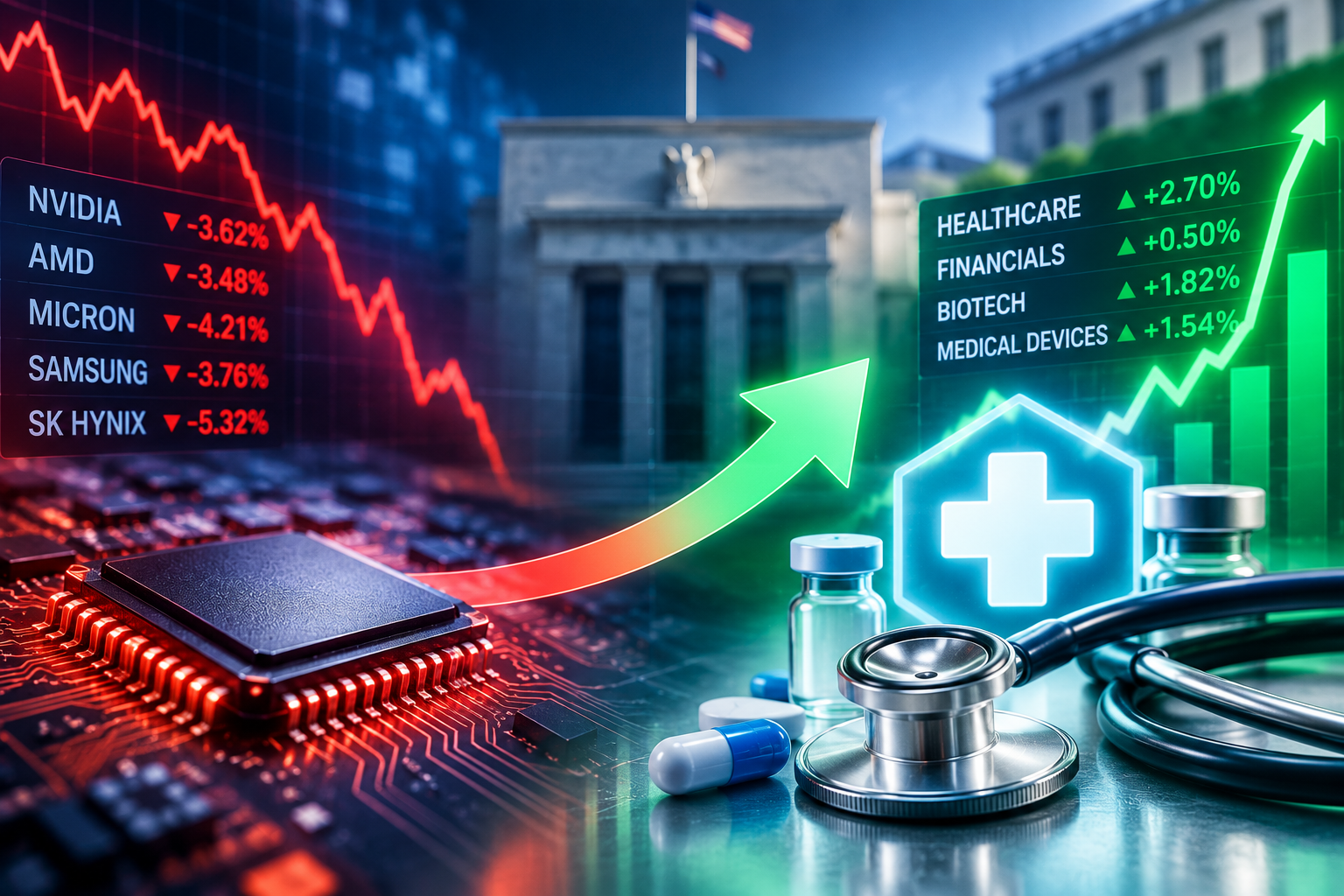
South Korean chipmakers suffered some of the steepest declines seen this year. SK Hynix dropped nearly 15% during the trading session, while Samsung Electronics lost more than 13% as investors rushed to lock in profits after an extraordinary rally that had driven semiconductor valuations to record levels throughout the first half of 2026.
The selling pressure quickly crossed into U.S. premarket trading.
Micron Technology fell more than 4%, while Intel and AMD each declined over 3%. Nvidia, one of Wall Street’s strongest AI beneficiaries, also slipped roughly 1.2%. The weakness pushed Nasdaq futures lower, highlighting the semiconductor industry’s outsized influence on broader equity markets.
Although the declines appear significant, many analysts note that the sector remains one of the strongest performers of the year. Several AI-related companies are still posting triple-digit gains for 2026, suggesting that the current sell-off may represent a valuation reset rather than a complete reversal of the long-term artificial intelligence investment theme.
Why Investors Are Questioning High AI Valuations
Artificial intelligence has been the dominant investment narrative over the past two years.
Demand for AI infrastructure—including GPUs, high-bandwidth memory, advanced storage, and cloud computing—generated record earnings growth across much of the semiconductor industry. Companies supplying memory chips benefited enormously as hyperscale cloud providers accelerated investments in next-generation data centers.
However, as stock prices continued climbing, valuations became increasingly difficult to justify.
Many portfolio managers now believe expectations have become too optimistic, particularly as investors await additional evidence that AI spending will continue expanding at its current pace. With many semiconductor companies trading at historically elevated multiples, even minor disappointments can trigger aggressive profit-taking.
The recent chip stocks slide illustrates how quickly sentiment can shift when markets become heavily concentrated in a single investment theme.
Chip Stocks Slide as Investors Rotate Toward Healthcare
While technology stocks weakened, defensive sectors attracted fresh buying interest.
Healthcare stocks led market gains, with the Health Care Select Sector SPDR ETF (XLV) rising approximately 2.7%. Pharmaceutical companies, medical device manufacturers, and healthcare service providers benefited from investors seeking businesses with relatively stable earnings regardless of economic conditions.
Financial stocks also advanced, with the Financial Select Sector SPDR ETF (XLF) gaining roughly 0.5%.
Banks and insurance companies often outperform during periods when interest rates remain elevated, making the sector attractive while uncertainty surrounds future Federal Reserve policy.
This sector rotation highlights a classic investment strategy frequently observed during periods of heightened market uncertainty. Rather than exiting equities entirely, investors simply shift capital from higher-risk growth sectors into industries considered more defensive.
Federal Reserve Decision Becomes the Market’s Primary Focus
The timing of the semiconductor sell-off is particularly significant because investors are preparing for the latest Federal Open Market Committee (FOMC) policy announcement.
Market participants widely expect the Federal Reserve to leave its benchmark interest rate unchanged within the 3.50% to 3.75% range.
Although inflation has moderated considerably from its post-pandemic highs, price pressures remain above the Federal Reserve’s long-term 2% target.
As a result, policymakers have emphasized the importance of maintaining a data-dependent approach before considering additional interest rate cuts.
For investors, the decision itself may be less important than the language accompanying the policy statement.
Fed Blackout Period Limits Market Guidance
Adding to market uncertainty is the Federal Reserve’s pre-meeting blackout period.
During this scheduled communications blackout, Federal Reserve officials refrain from making public comments about monetary policy.
Without speeches or interviews from policymakers, investors have fewer signals regarding how the central bank is interpreting recent economic data.
This information vacuum often contributes to higher market volatility during the days immediately preceding an FOMC announcement.
Geopolitical Risks Add Another Layer of Uncertainty
Global markets are also responding to renewed geopolitical tensions.
Fresh fighting in the Middle East has reignited concerns over energy supplies and global trade routes.
The escalation pushed crude oil prices higher overnight, increasing worries that energy inflation could complicate the Federal Reserve’s efforts to bring inflation back toward its target.
The ongoing chip stocks slide has become even more pronounced as investors balance geopolitical uncertainty with expectations for future interest-rate policy.
Is This Chip Stocks Slide a Correction or the Beginning of a Larger Trend?
Market strategists remain divided on the significance of the current semiconductor decline.
Some analysts argue the sell-off represents a healthy correction after extraordinary gains throughout the AI boom.
Others believe investors may continue reducing exposure to expensive technology shares if corporate earnings fail to justify current expectations.
Upcoming quarterly earnings from Nvidia, AMD, Intel, Micron Technology, and other AI-related companies could determine whether confidence in the semiconductor sector returns.
What Investors Should Watch Next
Several catalysts could determine market direction:
- Federal Reserve policy statement and Jerome Powell’s comments.
- Quarterly earnings from major semiconductor companies.
- Inflation and employment data published by the U.S. Bureau of Labor Statistics may influence future interest-rate expectations.
- Middle East geopolitical developments.
- Oil prices and global energy markets.
- Continued rotation into healthcare and financial stocks.
Together, these developments will determine whether the recent chip stocks slide proves temporary or marks the beginning of a broader market correction.
Outlook
The latest chip stocks slide reflects more than simple profit-taking. It highlights a market simultaneously navigating elevated AI valuations, persistent inflation concerns, geopolitical uncertainty, and an important Federal Reserve decision.
While enthusiasm surrounding artificial intelligence remains intact over the long term, investors are becoming increasingly selective as valuations stretch and macroeconomic risks intensify.
Healthcare and financial stocks continue attracting defensive capital, but leadership could quickly shift again depending on economic data and corporate earnings.
Until greater clarity emerges, investors should expect elevated volatility across global equity markets. Although the current chip stocks slide has pressured technology shares, long-term demand for AI infrastructure and advanced semiconductors remains one of the strongest structural themes in global markets.