The estimated reading time for this post is 380 seconds
For finance teams, forecasting has always been a race against time. FP&A professionals are expected to update revenue projections, model expenses, assess cash flow and explain changing business conditions—often while the underlying data is still moving.
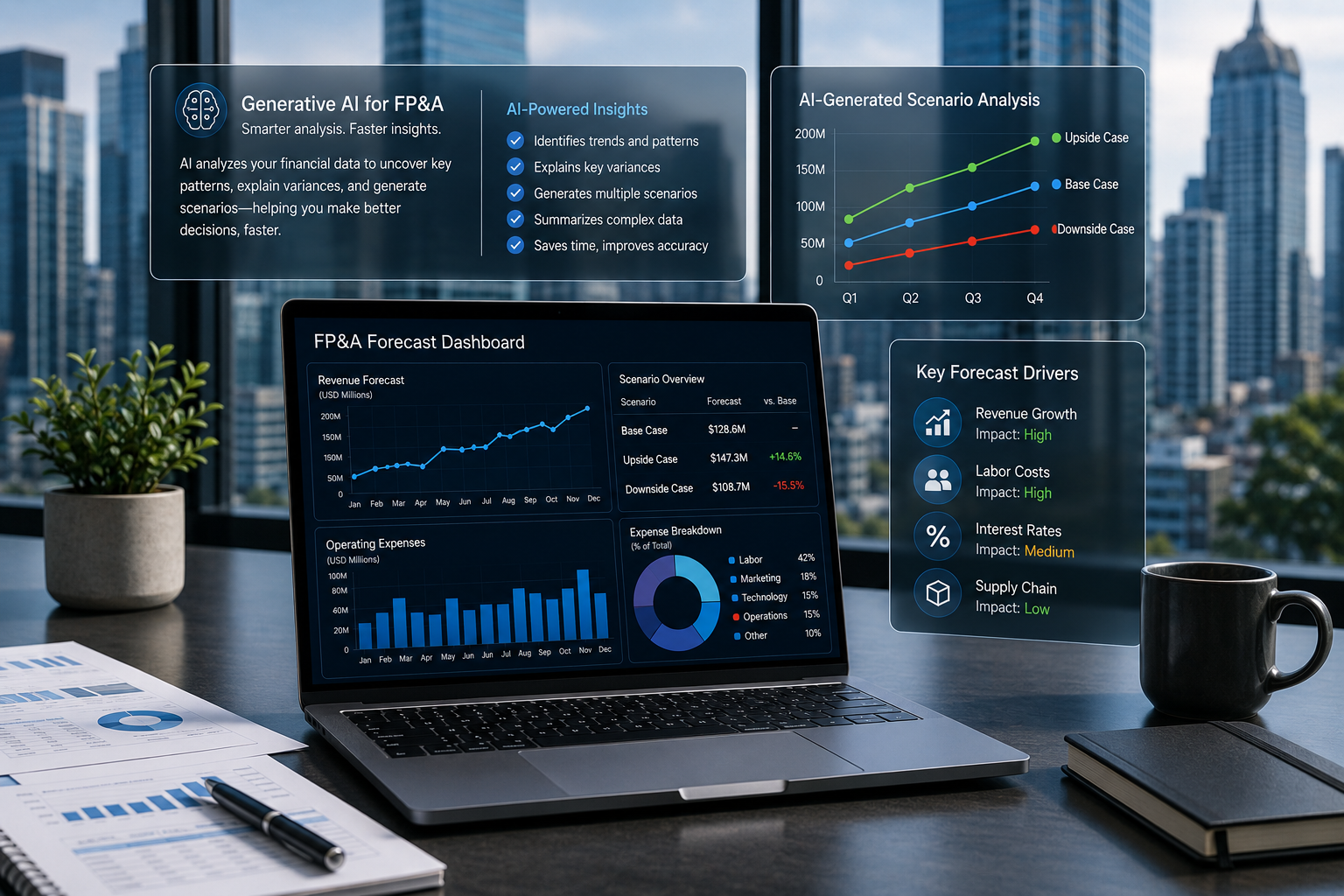
Now, generative AI for FP&A promises to accelerate that process. By leveraging generative AI in finance, modern tools can summarize financial data, identify patterns, generate scenarios and help finance teams produce forecasts faster.
But speed is not the same as accuracy.
The more important question for CFOs may be whether generative AI can improve the quality of financial forecasts—or simply make questionable assumptions look more sophisticated.
Generative AI Is Moving Into Finance
Interest in AI across finance is no longer theoretical. McKinsey’s 2025 survey of 102 CFOs found that 44% said their organizations were using generative AI for more than five finance use cases, compared with just 7% in the previous year’s survey. Another 65% said their organizations planned to increase generative AI investment.
The Association for Financial Professionals (AFP) has also documented growing AI experimentation in FP&A. Its 2025 FP&A Benchmarking Survey, based on 362 finance and FP&A practitioners, found that 23% were using AI on a daily, weekly or monthly basis, while another 40% were testing AI and planning implementation within the following year.
That makes forecasting a natural target.
Traditional FP&A processes can involve exporting data from ERP systems, cleaning spreadsheets, reconciling actuals, updating assumptions and rebuilding scenarios. Generative AI for FP&A can potentially reduce the manual work involved in those steps.
But the forecast itself still depends on the quality of the underlying information.
How Generative AI for FP&A Is Changing Finance
The strongest use case may not be asking an AI model to independently predict next year’s revenue.
Instead, generative AI can function as an analytical layer around established forecasting models.
For example, an FP&A team could use AI to identify unusual movements in revenue, compare actual results with the previous forecast, summarize the largest variances and generate explanations for management.
AI can also help create multiple scenarios.
Instead of maintaining a single base-case forecast, finance teams can evaluate questions such as:
- What happens if revenue growth falls 5% below plan?
- What happens if labor costs increase faster than expected?
- How would higher interest rates affect cash flow?
- Which expenses could be reduced if demand weakens?
This is particularly useful because FP&A is not simply about predicting one number. It is about understanding the range of outcomes management may face.
IBM’s research on the AI advantage in finance similarly emphasizes the potential for AI to strengthen finance operations and decision-making rather than simply automate individual tasks.
The Data Problem Has Not Disappeared
Generative AI for FP&A does not eliminate one of FP&A’s oldest problems: unreliable or fragmented data.
AFP’s 2025 research found that many FP&A teams still depend heavily on spreadsheets and struggle with data accessibility and reliability. Seventy-one percent of respondents reported using enterprise performance management tools for planning, but spreadsheets remained deeply embedded in the process.
That creates a simple problem.
If an AI system receives incomplete sales data, inconsistent expense classifications or outdated assumptions, it can produce a polished analysis based on flawed inputs.
The result may look more professional than a spreadsheet error, but it is still an error.
This is why generative AI for FP&A should generally sit on top of strong data governance, defined financial models and controlled assumptions.
Faster Does Not Necessarily Mean More Accurate
Recent research provides an important warning for finance executives.
A 2026 Federal Reserve Bank of San Francisco working paper evaluated ChatGPT’s ability to produce real-time U.S. inflation forecasts. The researchers found that the model’s out-of-sample forecasts were largely inaccurate and stale, even though results from some pseudo-out-of-sample experiments appeared comparable with traditional benchmarks. The researchers emphasized the importance of genuine out-of-sample testing.
The lesson for corporate FP&A forecasting is not that AI cannot forecast.
It is that AI-generated forecasts need to be tested against actual outcomes.
A model that produces an impressive forecast during a demonstration is not necessarily reliable when market conditions, customer behavior or company-specific circumstances change.
The Human Role Becomes More Important
The best model for generative AI for FP&A may therefore be human-plus-machine rather than fully autonomous forecasting.
AI forecasting tools can process large volumes of information quickly. Finance professionals understand the context behind the numbers.
A sudden decline in revenue, for example, could indicate weakening demand. But it could also reflect a major customer delaying an order, a one-time accounting adjustment or a temporary supply disruption.
An AI system may identify the variance quickly. An experienced FP&A professional can determine whether the variance should actually change the forecast.
That distinction matters.
The CFO’s job is not simply to obtain a number. It is to understand why the number changed and what management should do about it.
Forecast Accuracy Needs a Scorecard
One of the biggest weaknesses in AI-enabled forecasting could be failing to measure whether forecasts actually improve.
AFP reported in 2026 that only 14% of finance teams formally track forecast accuracy, meaning the majority do not have a structured measurement of how reliable their forecasts are.
That is a significant governance gap.
Companies adopting AI should establish benchmarks before deployment. Forecasts can be evaluated using measures such as mean absolute error, forecast bias and variance against actual results.
The comparison should also distinguish between:
Human forecast: What the FP&A team originally expected.
AI-assisted forecast: What the team produced with AI support.
Actual result: What ultimately happened.
Over several forecasting cycles, this creates evidence about whether AI is genuinely improving performance.
Without that measurement, “AI-powered forecasting” can become more of a technology claim than a financial advantage.
What CFOs Should Watch
For finance leaders considering generative AI, the immediate priority should not be replacing the forecasting process.
It should be strengthening it.
A practical approach is to begin with lower-risk applications: variance analysis, management reporting, scenario generation, data summarization and forecasting support.
The AI system should have access to controlled data, clear assumptions and appropriate permissions. Forecast outputs should remain reviewable, traceable and subject to human approval.
This approach also addresses another challenge identified by McKinsey: many AI initiatives struggle to scale because pilots fail to integrate with real-world processes and new data.
In other words, AI should become part of the finance workflow—not a separate experiment sitting beside it.
Read more: AI Hallucinations in Financial Reports: Why Human Review Still Matters
Faster Forecasts, Better Decisions
So, is generative AI for FP&A producing faster forecasts or simply faster guesses?
The answer depends largely on how companies deploy it.
Generative AI can make forecasting workflows significantly faster. It can surface patterns, automate repetitive analysis and help finance teams explore more scenarios in less time.
But speed alone does not make a forecast accurate.
The emerging evidence suggests that AI should be treated as an analytical assistant rather than an unquestionable source of financial truth. Strong data, tested models, human judgment and continuous measurement remain essential.
For CFOs, the real opportunity is therefore not to ask AI to replace financial judgment.
It is to use AI to give finance professionals more time to exercise it.