
The estimated reading time for this post is 300 seconds
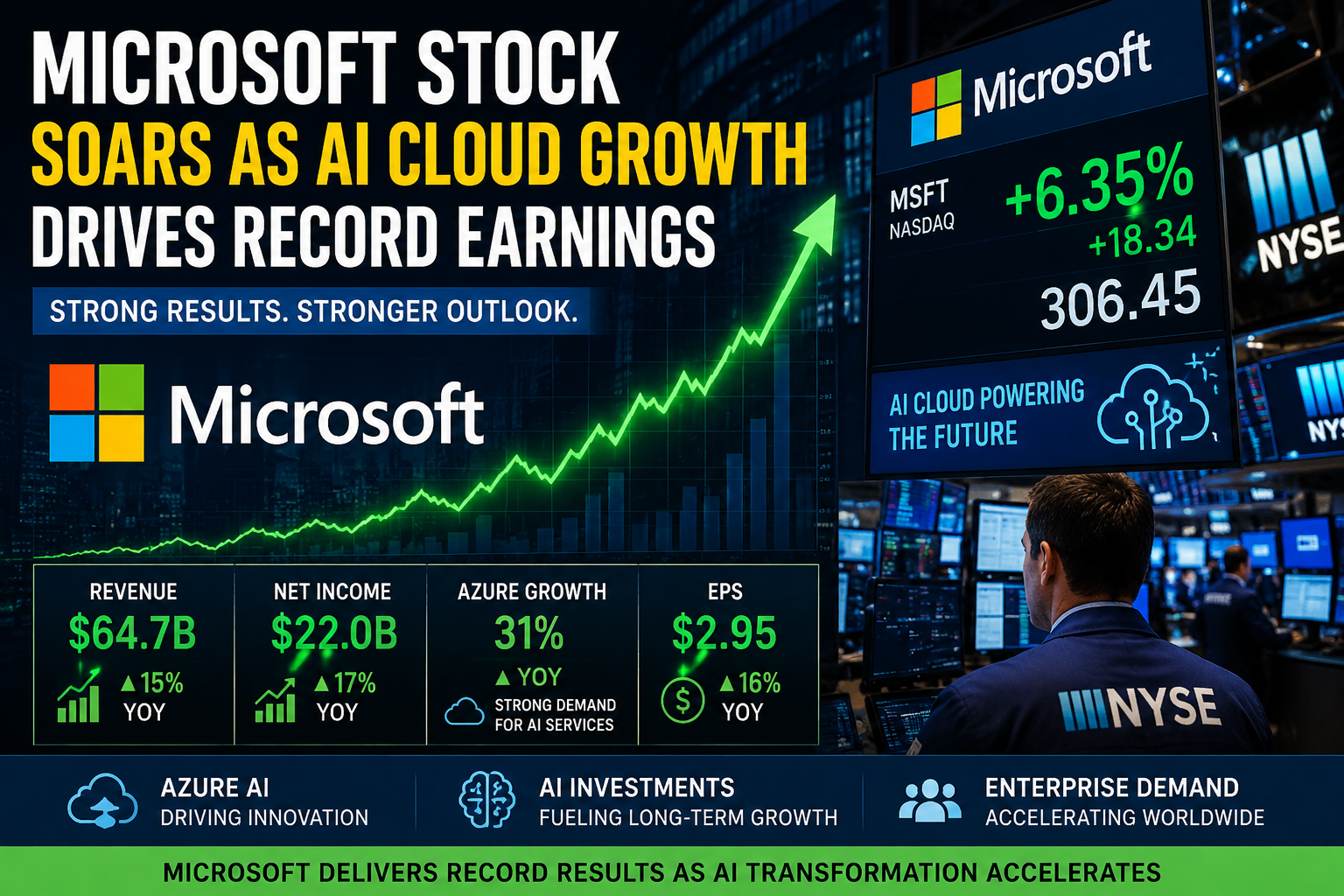
Microsoft stock surged after the company reported stronger-than-expected quarterly earnings, fueled by accelerating demand for artificial intelligence services and continued expansion of its Azure cloud platform. The results reinforced investor confidence that AI investments are translating into meaningful revenue growth, helping Microsoft remain one of Wall Street’s strongest performers in 2026.
The earnings report also boosted sentiment across the broader technology sector, with investors viewing Microsoft’s performance as another sign that enterprise spending on AI infrastructure remains resilient despite higher interest rates and ongoing macroeconomic uncertainty.
Microsoft stock attracted strong buying interest immediately after the earnings release as investors welcomed stronger cloud growth and expanding artificial intelligence revenue.
Strong Earnings Exceed Wall Street Expectations
Microsoft reported quarterly revenue and earnings above analyst forecasts, supported by double-digit growth across its cloud computing, enterprise software, and AI businesses.
Azure continued to be one of the company’s largest growth drivers as corporations expanded investments in cloud migration and generative AI applications. Demand for Microsoft’s AI-powered services, including Copilot and enterprise automation tools, remained strong across multiple industries.
The better-than-expected results reassured investors that Microsoft is successfully monetizing its substantial investments in artificial intelligence while maintaining healthy profit margins.
The latest earnings report reinforced confidence that Microsoft stock remains one of the strongest large-cap technology investments on Wall Street.
Azure AI Cloud Business Continues to Expand
Cloud computing remains the foundation of Microsoft’s long-term growth strategy.
The Azure platform has benefited from increasing demand for AI model training, enterprise data processing, cybersecurity solutions, and business productivity software.
Many large corporations continue shifting workloads to cloud infrastructure while integrating generative AI into daily operations. This trend has strengthened Microsoft’s competitive position against other major cloud providers.
Many analysts believe Microsoft stock could continue outperforming if Azure maintains its current pace of AI-driven revenue growth.
Analysts believe Azure’s consistent growth demonstrates that enterprise AI adoption is moving beyond experimentation into large-scale commercial deployment.
AI Spending Remains a Key Growth Driver
Artificial intelligence has become one of the most important investment themes on Wall Street.
Technology companies continue investing billions of dollars in data centers, advanced semiconductor chips, and cloud infrastructure to support rapidly growing AI workloads.
Microsoft’s partnership with OpenAI has positioned the company at the center of this transformation, allowing it to integrate AI capabilities across Microsoft 365, Azure, GitHub, Dynamics, and enterprise software products.
Investors increasingly view Microsoft’s diversified business model as providing greater stability compared with companies that rely heavily on consumer demand.
Wall Street Responds Positively
Following the earnings announcement, Microsoft stock moved sharply higher as institutional investors increased exposure to large-cap technology companies.
The positive reaction also lifted sentiment across the Nasdaq, with investors viewing Microsoft’s earnings as evidence that AI-driven growth remains intact despite concerns surrounding elevated valuations.
Portfolio managers noted that companies capable of consistently generating strong free cash flow while investing aggressively in AI continue attracting long-term institutional capital.
Institutional investors increased exposure to Microsoft stock as the company’s AI strategy continued exceeding market expectations.
What Investors Are Watching Next
Although Microsoft’s latest earnings strengthened confidence, investors continue monitoring several important factors.
These include:
- Future Azure revenue growth
- Enterprise AI adoption rates
- Capital expenditures for AI infrastructure
- Cloud profit margins
- Corporate software spending
- Global economic conditions
Any slowdown in these areas could influence future revenue expectations.
AI Competition Continues to Intensify
Microsoft faces increasing competition from several major technology companies expanding their AI capabilities.
Alphabet continues investing heavily in Google Cloud and Gemini AI models, while Amazon Web Services remains the global leader in cloud infrastructure.
Meta Platforms is also increasing AI-related spending through large language models and advertising technology improvements.
Despite stronger competition, Microsoft remains well positioned because of its extensive enterprise customer base, integrated productivity ecosystem, and long-term cloud contracts.
Broader Market Impact
Microsoft’s earnings have implications beyond a single company.
Because Microsoft represents one of the largest components of the S&P 500 and Nasdaq 100, its financial performance often influences broader market sentiment.
Strong earnings from one of the world’s largest companies may encourage investors to remain optimistic about corporate profitability, particularly within the technology sector.
At the same time, analysts caution that high valuations leave little room for disappointment during future earnings seasons.
Because Microsoft stock represents one of the largest companies in both the Nasdaq 100 and S&P 500, its performance often influences overall market sentiment.
How AI Is Reshaping Corporate Investment
Artificial intelligence is no longer viewed as an experimental technology. Instead, businesses increasingly consider AI an essential component of long-term productivity and operational efficiency.
Companies are investing in automation, predictive analytics, cybersecurity, software development, customer support, and digital infrastructure powered by AI.
Microsoft has positioned itself to benefit from nearly every stage of this transformation, from cloud infrastructure to enterprise software subscriptions.
This diversified exposure gives investors confidence that AI-related revenue opportunities may continue expanding for years.
Risks Investors Should Consider
Despite the strong earnings report, several risks remain.
Higher interest rates could reduce corporate technology spending if economic growth slows.
Increased competition may pressure pricing within cloud computing.
Regulatory scrutiny surrounding artificial intelligence, cybersecurity, and data privacy could also create new compliance costs.
Finally, continued heavy investment in AI infrastructure may temporarily reduce profit margins before additional revenue fully materializes.
Looking ahead, Microsoft stock will remain one of the most closely watched technology shares as investors evaluate future AI spending, Azure cloud growth, and enterprise demand.
Outlook
Microsoft’s latest earnings reinforce the growing belief that artificial intelligence remains one of the most powerful long-term investment themes in global markets.
If enterprise demand for AI services continues expanding, Microsoft appears well positioned to benefit through Azure, productivity software, and cloud infrastructure.
However, investors will continue monitoring Federal Reserve policy, Treasury yields, and corporate technology spending for signs that economic conditions remain supportive.
As Wall Street prepares for another round of corporate earnings, Microsoft stock is likely to remain one of the market’s most closely watched technology leaders.