
The estimated reading time for this post is 347 seconds
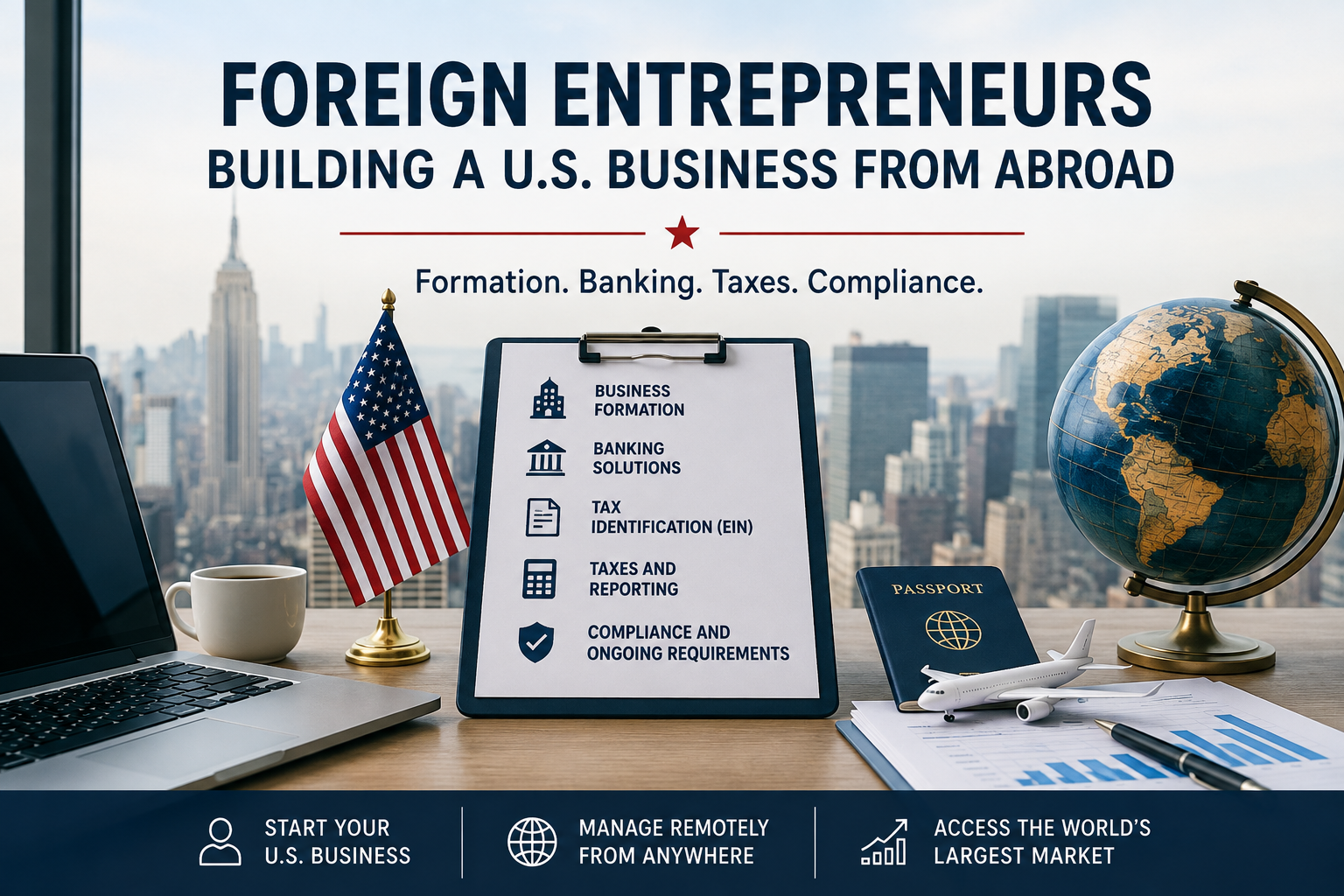
Foreign entrepreneurs U.S. business owners can establish and manage a U.S. company without necessarily living in the United States. However, forming a company is only the beginning. International founders may also need to consider business structure, state registration, registered agents, tax identification, banking, taxation and ongoing compliance.
In many cases, foreign entrepreneurs can own and establish a U.S. business while living abroad. However, company formation is only the first step. Entrepreneurs may also need to consider business structure, state registration, registered agents, tax identification, banking, taxes and ongoing compliance.
Here are the main issues international founders should understand.
1. Foreign Entrepreneurs: Choose the Right Business Structure
The first decision is choosing the appropriate business structure.
Many small businesses consider a limited liability company, or LLC, because of its flexible structure. Corporations may be more suitable for businesses planning to raise outside investment or maintain a more formal ownership structure.
The U.S. Small Business Administration explains that business structure can affect taxes, personal liability, paperwork and fundraising.
An LLC also does not automatically receive one fixed federal tax classification. Its treatment can depend on factors such as ownership and elections made with the IRS.
For foreign entrepreneurs, the choice can also affect how U.S. income is treated alongside tax obligations in their home country.
2. Choose Where to Form the Business
U.S. businesses are generally organized under state law. Therefore, selecting a formation state requires more than comparing filing fees.
Entrepreneurs should consider where the business will operate, state taxes, annual reporting requirements and whether the company may need to register in another state.
The cheapest state to form a company is not necessarily the most appropriate state for a particular business.
Foreign founders should focus on the company’s actual activities and long-term plans when making this decision.
3. Understand the Registered-Agent Requirement
A registered agent generally receives official legal and government correspondence for a business.
This can be especially important for foreign entrepreneurs who do not maintain a physical address in the United States.
Business-service providers may offer registered-agent and company-formation services. Entrepreneurs should compare pricing, state coverage, renewal fees and the services included.
One Service to Compare
Zenind is one business-service provider that foreign entrepreneurs can evaluate when comparing U.S. company formation and registered-agent services.
4. Consider the EIN
An Employer Identification Number, or EIN, is a federal tax identification number issued by the IRS.
An EIN may be required for various federal tax and business purposes. Foreign applicants should pay particular attention to IRS requirements when they do not have a Social Security number or other U.S. taxpayer identification number.
The IRS provides specific instructions for international applicants through Form SS-4.
Entrepreneurs who are comparing formation services may also find providers offering assistance with administrative steps related to company formation.
5. Banking Is a Separate Process
Forming a U.S. company does not automatically guarantee access to a U.S. business bank account.
Banks can have their own identification and verification requirements. A foreign founder may need to provide formation documents, identification, tax information and information about the company’s ownership and activities.
Requirements can vary between financial institutions.
For that reason, international entrepreneurs should research banking requirements before forming a company instead of assuming that company formation and banking are one process.
6. Understand U.S. and International Taxes
Tax planning is one of the most important issues for foreign entrepreneurs.
A U.S. business can create federal and state tax or reporting obligations. At the same time, the owner may have tax responsibilities in their country of residence.
The outcome can depend on the company’s entity classification, ownership, income, business activities and applicable tax treaties.
Certain foreign-owned U.S. entities may also have additional information-reporting requirements. The IRS provides specific rules for Form 5472 in applicable situations.
Because cross-border taxation can become complicated, entrepreneurs should not assume that a standard U.S. LLC produces the same tax result for every foreign owner.
7. Plan for Ongoing Compliance
Forming a company is only the beginning.
Depending on the state and business structure, a company may need to file periodic reports, pay state fees and maintain current business information.
Foreign entrepreneurs should also monitor federal requirements.
Beneficial Ownership Reporting
Beneficial ownership information, or BOI, rules have changed. FinCEN currently states that entities created in the United States and their beneficial owners are exempt from BOI reporting under the current rule.
Certain entities formed under foreign law and registered to do business in the United States may still be subject to reporting requirements.
Because regulations can change, entrepreneurs should check current FinCEN guidance instead of relying on older formation articles.
Can You Run a U.S. Business From Abroad?
For many business models, yes.
Technology allows entrepreneurs to manage companies, communicate with customers and work with business partners without living in the United States.
However, owning a U.S. company is different from having permission to work physically in the United States.
Company ownership does not automatically provide U.S. immigration status or employment authorization. Entrepreneurs planning to relocate or perform business activities physically in the country should review the immigration rules applicable to their situation.
What Foreign Entrepreneurs Should Prepare
Before forming a U.S. business, international founders should consider:
- Business structure — Choose an appropriate LLC, corporation or other entity.
- Formation state — Consider where the company will operate.
- Registered agent — Arrange a reliable address for official correspondence.
- EIN — Review IRS requirements for foreign applicants.
- Banking — Check account-opening requirements.
- Taxes — Review U.S. and home-country tax obligations.
- Compliance — Plan for ongoing state and federal requirements.
- Immigration — Review separate rules if planning to work physically in the United States.
Considering a U.S. Company?
Foreign entrepreneurs can establish a U.S. business without necessarily relocating, but choosing the right structure and service providers requires careful planning.
If you are comparing company formation and registered-agent services, Zenind is one option to evaluate alongside other providers.
Read more: LLC vs Corporation: 7 Key Differences U.S. Business Owners Should Know
Final Takeaway
Foreign entrepreneurs do not necessarily need to live in the United States to own a U.S. business.
However, international ownership involves more than filing formation documents. Business structure, state registration, registered agents, EIN requirements, banking, taxation and ongoing compliance should all be considered.
The key distinction is simple: forming a U.S. company does not automatically solve banking, tax or immigration requirements.
Entrepreneurs should use current government guidance and seek qualified professional advice when tax, legal or immigration consequences are significant.
Sources
- U.S. Small Business Administration — Choose a Business Structure
- IRS — Instructions for Form SS-4
- IRS — Instructions for Form 5472
- IRS — Tax Treaties
- FinCEN — Beneficial Ownership Information
- U.S. Department of State — Business Travel
- Zenind — U.S. Company Formation Services
Editorial Disclaimer: This article is for general informational purposes only and does not constitute legal, tax, accounting or immigration advice. Requirements may vary based on the entrepreneur, business structure, state and individual circumstances.