
The estimated reading time for this post is 361 seconds
When a corporate executive sells company stock, investors often ask the same question: Was the sale planned, or did the executive know something the market did not?
That question sits at the center of Rule 10b5-1, a Securities and Exchange Commission (SEC) rule governing when securities trades may qualify for an affirmative defense against insider trading liability.
The rule does not make insider trading legal. Instead, it establishes conditions under which a person can demonstrate that a trade was not made “on the basis of” material nonpublic information, commonly known as MNPI.
The SEC significantly strengthened the framework in 2022, adding cooling-off periods, good-faith requirements, limits on overlapping plans and additional disclosure requirements. Those changes became effective in February 2023, with various compliance requirements phased in afterward.
Here is what investors and corporate insiders should understand.
What Is Rule 10b5-1?
Rule 10b5-1 operates under Section 10(b) of the Securities Exchange Act of 1934 and Rule 10b-5.
In plain English, the rule addresses situations where someone buys or sells a security while aware of material nonpublic information and has a relevant duty of trust or confidence.
The rule provides an affirmative defense when specific conditions are satisfied.
Under the regulation, an individual can potentially establish that a trade was not based on MNPI if, before becoming aware of that information, the person had entered into a binding contract, instructed another person to trade, or adopted a written trading plan.
That distinction is important.
A Rule 10b5-1 plan is not a permission slip to trade on inside information. It is a framework designed to separate the decision to trade from later knowledge of potentially market-moving information.
How a 10b5-1 Trading Plan Works
Consider a hypothetical chief financial officer who owns 100,000 shares of company stock.
Before the company begins preparing for a major acquisition, the CFO establishes a written trading plan that specifies when shares will be sold and under what conditions.
If the plan meets the requirements of Rule 10b5-1, the trades can potentially qualify for the rule’s affirmative defense even if the executive later becomes aware of material nonpublic information.
The key is that the trading instructions must be established before the person becomes aware of the information and must satisfy the rule’s conditions.
The regulation allows a plan to specify the amount, price and date of transactions. It can also use a written formula, algorithm or computer program to determine those terms. Alternatively, the plan can remove the individual’s subsequent ability to influence whether, when or how trades occur.
That is why the details of the plan matter.
The 2022 SEC Changes
The SEC adopted major amendments to Rule 10b5-1 in December 2022 after concerns that the original framework could be manipulated by insiders.
The amendments introduced several important safeguards, including cooling-off periods, certifications for directors and officers, restrictions on overlapping trading plans and limits on certain single-trade arrangements.
One of the most important changes is the cooling-off period.
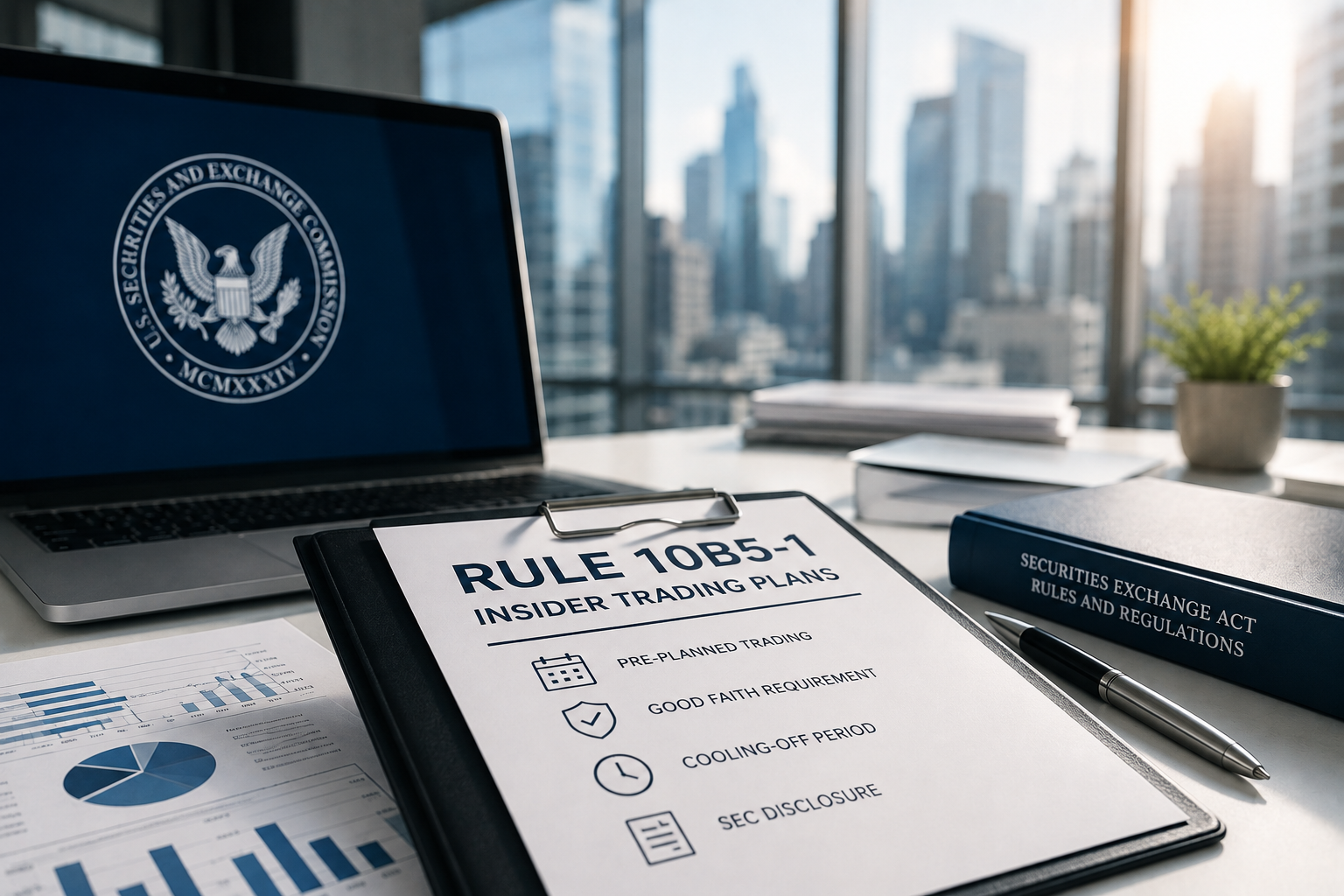
For directors and officers, trades generally cannot begin until the later of 90 days after adoption of the plan or two business days following disclosure of the issuer’s financial results for the fiscal period in which the plan was adopted. The applicable period cannot exceed 120 days.
For other persons, the cooling-off period is generally 30 days.
The objective is straightforward: create more distance between the creation of a trading plan and the first transaction.
Good Faith Is Now a Continuing Requirement
Another important change is the rule’s good-faith requirement.
A person seeking the affirmative defense must have entered into the contract, instruction or plan in good faith and not as part of a scheme to evade the insider trading rules. The person must also act in good faith with respect to the plan.
For directors and officers, the rule goes further.
When adopting a new or modified Rule 10b5-1 plan, they must certify that they are not aware of material nonpublic information about the issuer or its securities and that the plan is being adopted in good faith rather than as part of an attempt to evade Rule 10b-5.
That makes the process more than simply signing a document and handing trading decisions to a broker.
Can Insiders Change a 10b5-1 Plan?
This is one of the areas where investors should pay close attention.
The current rule treats changes to the amount, price or timing of trades as a termination of the existing plan and adoption of a new one. In practical terms, changing the core trading instructions can restart the regulatory framework that applies to a new plan.
The SEC also restricted the use of multiple overlapping plans.
The amendments generally prevent persons other than issuers from maintaining multiple outstanding arrangements that would qualify for the Rule 10b5-1 affirmative defense for open-market purchases or sales, subject to specified exceptions.
The rules also limit reliance on the affirmative defense for certain single-trade plans to one such plan during a 12-month period.
What Investors Can See
The SEC’s 2022 amendments also expanded disclosure.
For insiders filing Forms 4 or 5, transactions intended to satisfy the Rule 10b5-1 affirmative-defense conditions must be identified with a checkbox, and the filing must disclose the date the trading plan was adopted.
The rules also moved bona fide gifts of securities that previously could have been reported on Form 5 into Form 4 reporting.
For investors, these disclosures provide additional context when evaluating insider transactions.
An executive selling shares under a previously established trading plan is different from an executive deciding to sell shares immediately after learning information that could affect the company’s stock price.
Still, the existence of a 10b5-1 plan should not automatically be interpreted as proof that a transaction is economically insignificant or bullish. Investors should consider the size, timing, frequency and broader circumstances surrounding the transaction.
Why Rule 10b5-1 Matters
Insider transactions can provide useful information about corporate executives’ financial decisions, but they can also create confusion when investors do not know whether a transaction was planned in advance.
Rule 10b5-1 attempts to address that problem by establishing a structured framework for predetermined trading arrangements.
The SEC’s amendments were designed to reduce opportunities for opportunistic use of those arrangements while improving transparency for shareholders.
For corporate insiders, the lesson is equally straightforward: a trading plan needs to be established carefully, maintained in good faith and operated within the rule’s requirements.
For investors, the key takeaway is to look beyond the headline that an executive “sold shares.”
The more important questions are when the plan was adopted, whether the transaction was made under that plan, what the plan disclosed, and whether the trade fits the requirements of Rule 10b5-1.
In today’s market, understanding those details can make insider trading disclosures far more useful—and far less misleading.
Read more: Materiality in SEC Filings: How Companies Decide What Must Be Disclosed
Sources
- U.S. Securities and Exchange Commission (SEC), SEC Adopts Amendments to Modernize Rule 10b5-1 Insider Trading Plans and Related Disclosures
- U.S. Securities and Exchange Commission (SEC), Insider Trading Arrangements and Related Disclosures — Small Entity Compliance Guide
- 17 CFR § 240.10b5-1, Trading “on the basis of” material nonpublic information in insider trading cases