
The estimated reading time for this post is 444 seconds
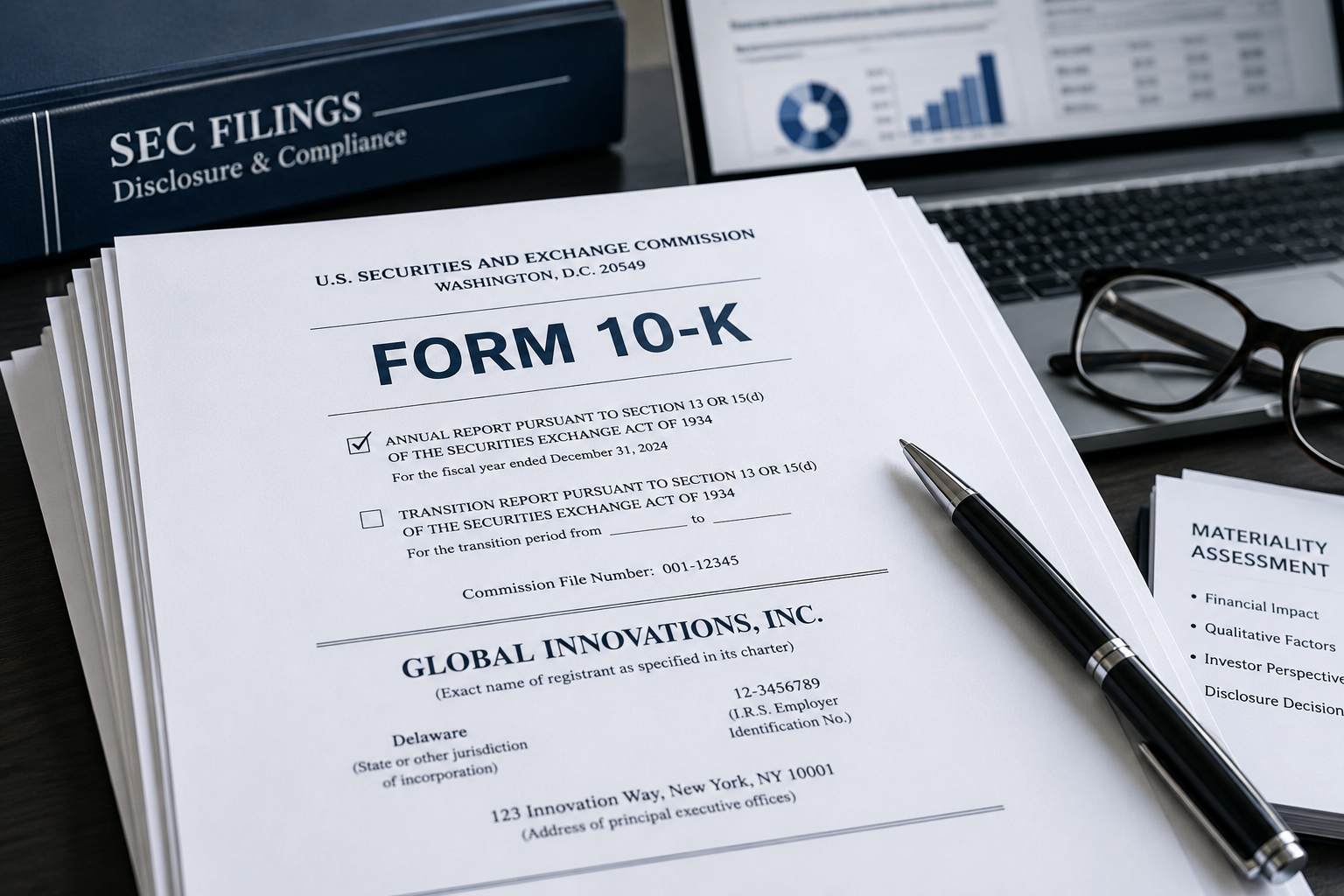
Materiality in SEC filings plays a central role in determining what public companies must disclose to investors. When a company files a Form 10-K, 10-Q, or 8-K with the U.S. Securities and Exchange Commission (SEC), not every business development or financial detail automatically becomes a public disclosure.
One of the most important questions is whether the information is material. Materiality helps determine whether information could be important to a reasonable investor when making an investment decision.
Materiality helps determine whether information could be important to a reasonable investor when making an investment decision. The standard is not simply about how large a number appears on a company’s financial statements. Companies are expected to consider both quantitative and qualitative factors, as well as the broader circumstances surrounding the information.
That judgment has become increasingly important as public companies deal with cybersecurity incidents, artificial intelligence, litigation, regulatory changes, climate-related events and other risks that may develop faster than traditional financial reporting cycles.
What Does Materiality in SEC Filings Mean?
The SEC’s approach to materiality is rooted in U.S. Supreme Court precedent.
In TSC Industries, Inc. v. Northway, Inc. (1976), the Court established a standard based on whether there is a substantial likelihood that a reasonable shareholder would consider information important. The Supreme Court later applied the concept in Basic Inc. v. Levinson (1988), focusing on whether information would significantly alter the overall mix of information available to investors.
The SEC’s Staff Accounting Bulletin No. 99, issued in 1999, reinforces this approach. It warns against relying exclusively on numerical benchmarks when determining materiality.
In practical terms, the question is broader than “How much money is involved?”
The more important question is whether the information could reasonably affect how an investor evaluates the company.
Materiality Is More Than a Dollar Amount
A common misconception is that a small financial amount is automatically immaterial. SEC guidance specifically cautions against that approach.
SAB 99 explains that a quantitatively small item can still be material depending on the circumstances. For example, an adjustment could become significant if it changes a company from a loss to a profit, affects compliance with a debt covenant, influences executive compensation or conceals an unlawful transaction.
Percentages can provide a useful starting point, but they do not create a universal safe harbor. The SEC has repeatedly emphasized that materiality requires consideration of the surrounding facts and circumstances.
This means a company can face a materiality issue even when the financial amount appears relatively small.
How Companies Assess Materiality
There is no single SEC-prescribed checklist that every public company must follow. In practice, materiality in SEC filings is evaluated through a combination of financial analysis, business context and the potential impact on investors, companies generally establish disclosure controls and procedures designed to identify, evaluate and report information that may require disclosure.
The process often begins by identifying a potentially significant event.
That could include a cybersecurity incident, major litigation, an executive departure, a significant acquisition, a regulatory investigation, a supply-chain disruption or a major change in business operations.
Finance and legal teams may then evaluate the potential financial impact. Revenue, expenses, assets, liabilities, cash flow and other financial measures can be relevant.
But the analysis does not stop at the numbers.
Companies may also consider qualitative factors. Could the event change an important business trend? Could it affect compliance with a financing agreement? Could it materially affect a major customer relationship? Could it change an investor’s understanding of the company’s business?
Many public companies also use disclosure committees or similar internal governance structures involving senior finance, legal, accounting, risk and investor-relations personnel. These structures can help coordinate disclosure decisions, although the SEC does not require every public company to maintain a committee with a specific name or structure.
Cybersecurity Has Made Materiality More Urgent
Cybersecurity is one of the clearest examples of how materiality operates in modern securities reporting.
The growing number of cybersecurity incidents has made materiality in SEC filings an increasingly important consideration for public companies.
In July 2023, the SEC adopted rules requiring public companies to disclose material cybersecurity incidents. Under the rules, a domestic registrant generally must file Form 8-K Item 1.05 within four business days after determining that a cybersecurity incident is material.
The disclosure covers material aspects of the incident, including its nature, scope and timing, as well as its material impact or reasonably likely material impact on the company.
The rules also added annual disclosure requirements covering cybersecurity risk management, strategy and governance.
Importantly, the trigger is materiality, not simply the existence of a cyber incident. A company can experience a cybersecurity event without automatically being required to make an Item 1.05 filing.
That distinction makes the internal materiality assessment particularly important.
Climate Disclosure Rules Remain in Transition
Climate-related disclosure provides another example of how regulatory requirements can evolve.
The SEC adopted climate-related disclosure rules in March 2024. Those rules were subsequently stayed while litigation proceeded. In March 2025, the SEC voted to end its defense of the rules.
On May 29, 2026, the SEC proposed rescinding the climate-related disclosure amendments entirely. The proposal argues for a more materiality-focused approach to securities disclosure. As of August 2026, however, the rescission remains a proposal, rather than a final rule.
That distinction matters for companies and investors.
Climate-related information can still be relevant under existing disclosure requirements when the facts and circumstances make it material. For example, a severe weather event that significantly damages facilities or disrupts operations could create disclosure considerations depending on its financial and business impact.
Artificial Intelligence Creates a New Materiality Question
Artificial intelligence is another developing area for public-company disclosures.
Companies increasingly discuss AI-related opportunities and risks in their SEC filings, particularly in risk factors, business descriptions and management discussions.
For companies evaluating AI-related risks, materiality in SEC filings depends on whether those risks could reasonably affect an investor’s assessment of the business.
The materiality question is not simply whether a company uses AI.
Instead, companies may consider whether AI-related developments could materially affect operations, financial condition, competitive position, regulatory exposure or future business prospects.
Potential issues include intellectual property disputes, regulatory requirements, data security, model reliability, dependence on technology providers and the cost of developing or deploying AI systems.
As with other emerging risks, the central question remains whether the information could be important to a reasonable investor.
What Happens When Companies Get It Wrong?
Materiality judgments can attract regulatory scrutiny.
The SEC may issue a comment letter asking a company to explain how it reached a particular disclosure conclusion or why certain information was omitted from a filing.
In more serious circumstances, inaccurate or incomplete disclosure can become the subject of an enforcement action.
The cybersecurity rules illustrate the importance of timely materiality determinations. The SEC’s compliance guidance states that companies should make the determination without unreasonable delay and file the required Form 8-K within four business days after determining that an incident is material.
The consequences can also extend beyond regulatory action. Disclosure problems may affect investor confidence, analyst expectations and the credibility of management.
Why Documentation Matters
Because materiality involves judgment, companies generally maintain records explaining how significant disclosure decisions were reached.
A well-documented process can identify the event considered, the financial information reviewed, the qualitative factors evaluated and the individuals involved in the decision.
Companies may also compare their disclosures with previous filings and relevant industry practices. However, peer benchmarking should not replace an independent analysis of the company’s own circumstances.
The goal is not to create a formula that automatically determines whether information is material. Instead, companies need a consistent process for identifying, evaluating and documenting potentially significant information.
Materiality Is Ultimately a Judgment
There is no single number that determines whether information must appear in an SEC filing.
Materiality depends on the circumstances, the nature of the information and its potential importance to investors. Quantitative analysis can provide an important starting point, but SEC guidance makes clear that qualitative considerations also matter.
That principle is increasingly relevant as public companies face risks that can develop faster than traditional financial reporting cycles.
Cybersecurity incidents can unfold within hours. AI regulations can change rapidly. Litigation can create significant exposure before its final financial impact is known. Operational disruptions can affect customers and supply chains before their full consequences appear in quarterly results.
For companies preparing SEC filings, materiality is therefore less about finding a perfect formula and more about understanding what information could change the way a reasonable investor views the business.
Disclaimer: This article is for informational purposes only and does not constitute legal or accounting advice.
Read more: State-by-State Corporate Tax Nexus Rules After Remote Work Expansion
Data Sources
- U.S. Securities and Exchange Commission — Staff Accounting Bulletin No. 99, Materiality.
- U.S. Securities and Exchange Commission — Cybersecurity Risk Management, Strategy, Governance, and Incident Disclosure.
- TSC Industries, Inc. v. Northway, Inc., 426 U.S. 438 (1976).
- Basic Inc. v. Levinson, 485 U.S. 224 (1988).