The estimated reading time for this post is 334 seconds
Corporate tax nexus has become a more important issue for companies with remote employees. Remote work has changed more than where employees sit. For finance departments, it can also affect where a company may have state tax filing obligations.
Before the remote-work expansion, businesses often focused on offices, warehouses, and sales personnel. Distributed teams added another variable: employees working from home in states where the company may not have a traditional business location.
That does not automatically mean every remote employee creates a corporate income tax obligation. State rules vary by tax type, business activity, and company circumstances. For CFOs and tax teams, the challenge in 2026 is understanding where activities may create tax nexus and keeping employee, payroll, property, and sales data aligned.
What Is Tax Nexus?
Tax nexus is the connection between a business and a state that can give the state authority to impose tax or require a filing.
States may consider physical presence, sales, payroll, property, employee services, and other business activities.
A company can have an obligation to register or file one type of state tax without necessarily owing another. Remote work has made this analysis more complicated because employee location can become part of a company’s state tax footprint. Understanding corporate tax nexus is therefore important for companies managing employees across multiple states.
How Remote Employees Can Affect Nexus
An employee working in another state can be relevant when determining whether a company is conducting business there. The result depends on state law and employee activities.
An employee performing sales, customer support, consulting, or other revenue-generating work may present a different nexus profile from someone performing limited internal duties. For companies with distributed teams, corporate tax nexus can become more difficult to monitor as employees change locations.
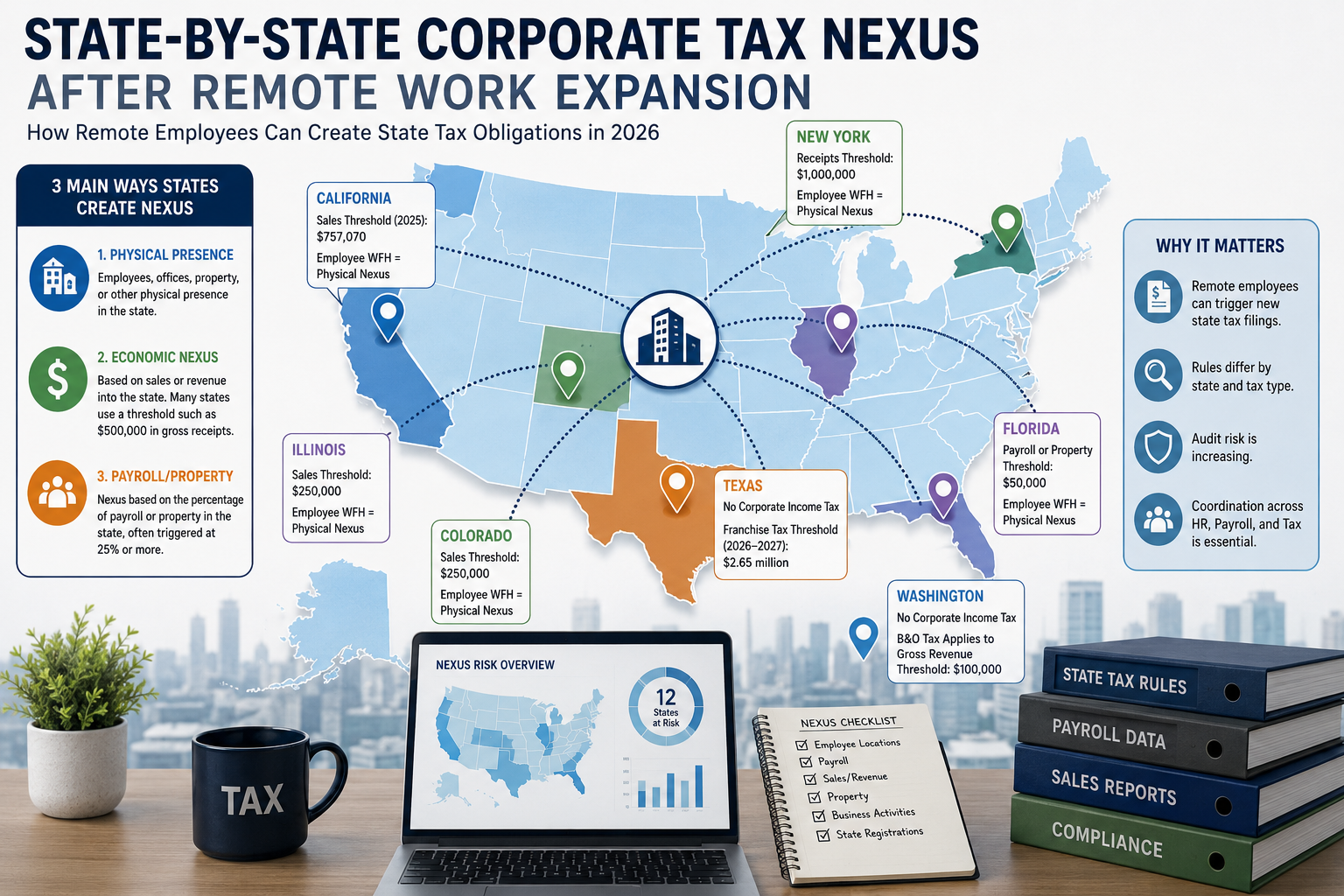
California illustrates why nexus cannot be reduced to one revenue threshold. The California Franchise Tax Board says a taxpayer can be considered to be doing business in California based on activities in the state, as well as certain sales, property, or payroll thresholds. For 2025, the published threshold was $757,070 for California sales and $75,707 for property and payroll.
Three Nexus Concepts CFOs Should Track
Physical presence: An office, property, or employee working in a state can potentially become relevant to nexus analysis.
Economic nexus: This generally focuses on business activity or revenue connected with a state. The concept became especially prominent after the U.S. Supreme Court’s 2018 South Dakota v. Wayfair decision. A sales-tax economic nexus threshold should not automatically be treated as a corporate income-tax threshold.
Payroll and property: Some states use payroll, property, or sales factors when determining whether an out-of-state business is doing business within the state. California, for example, publishes annual thresholds and references a 25% of total factor test.
| State | Key Remote-Work Consideration | 2026 Planning Note |
|---|---|---|
| California | Employee activity, payroll, property, and sales can be relevant to determining whether a taxpayer is doing business in the state. | California publishes annual sales, property, and payroll thresholds. The 2025 figures were $757,070 for sales and $75,707 for property and payroll. |
| New York | Employee activity can be relevant to corporate tax nexus and separate rules apply to nonresident employee taxation. | New York’s telecommuting rules should be analyzed separately for corporate and individual income-tax purposes. |
| Texas | Texas does not impose a traditional corporate income tax, but it imposes a franchise tax on taxable entities. | For 2026 and 2027, the Texas franchise-tax no-tax-due threshold is $2.65 million. |
| Florida | Florida has no individual income tax and its business tax environment differs from states that impose a broad corporate income tax. | Companies should distinguish corporate income-tax exposure from other state registration and tax obligations. |
| Illinois | Illinois has its own corporate income-tax and business activity rules. | Remote employees and business activity should be reviewed under Illinois-specific rules rather than applying another state’s threshold. |
| Colorado | Colorado imposes corporate income tax and has rules governing when an out-of-state business is subject to its tax system. | Companies with employees or significant sales in Colorado should conduct a state-specific nexus review. |
| Washington | Washington does not impose a traditional corporate income tax but does impose the Business & Occupation (B&O) tax. | The B&O system generally focuses on gross business income, making it different from a traditional net-income corporate tax. |
There is no single national definition of corporate tax nexus. Rules can differ by state and tax type.
The Remote Employee Problem
A compliance challenge is the employee who changes states without triggering an immediate tax review.
Consider a company headquartered in Texas whose engineer moves to another state and continues working remotely. For the employee, it may be a personal relocation. For the company, it can create a new state-tax question.
The answer depends on the state, employee duties, company activity, and tax involved.
What Companies Can Monitor
Payroll systems can help identify potential state exposure. Useful data includes employee work state, move dates, payroll assigned to the state, job function, travel, assigned property, and sales generated in different jurisdictions.
Companies may also use nexus tracking and remote-work policies to monitor geographic changes.
Safe harbors also require caution. Pandemic-era policies have changed over time, so a COVID-19 exception should not automatically be assumed to remain effective in 2026. Current rules should be checked state by state.
What CFOs Should Monitor
A practical review can begin with five questions:
- Where are employees physically working?
- What activities are they performing?
- Where are payroll and property assigned?
- Where are sales or receipts generated?
- Which states already require registration or filing?
The answers can then be reviewed against each state’s current rules.
Read more: Global Minimum Tax Pillar Two: What US Multinationals Need to Know in 2026
The Bottom Line
Remote work did not create one universal national rule for corporate tax nexus. Instead, it made state-by-state monitoring more important.
An employee working from home in another state may be relevant to a company’s tax analysis, but the consequences depend on the state, tax involved, employee activities, and broader company presence.
For CFOs and tax teams, the practical lesson is straightforward: employee location, payroll, sales, property, and business activity should be tracked together.
State tax rules continue to evolve, and thresholds can change from one tax year to another. Companies operating across multiple states should review official state guidance before relying on a specific threshold.
This article is for informational purposes only and does not constitute tax or legal advice. State tax rules can change and may vary based on individual business circumstances. Companies should consult a qualified tax professional regarding their specific situation.