
The estimated reading time for this post is 450 seconds
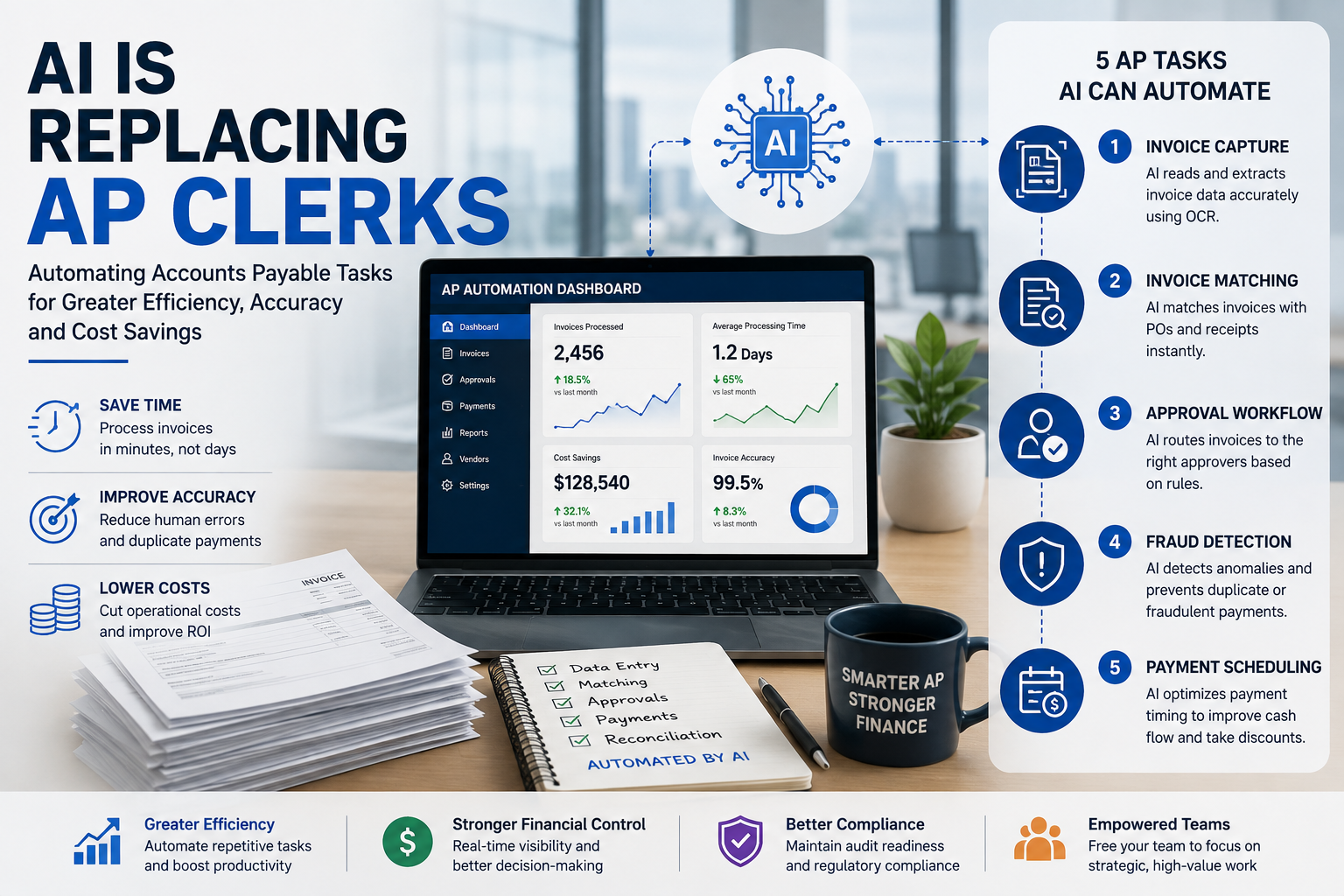
AI Is Replacing AP Clerks intelligence is transforming finance departments faster than many organizations expected. While AI won’t eliminate every accounting role overnight, it is rapidly changing how accounts payable (AP) teams operate. Manual data entry, invoice approvals, and payment reconciliation are increasingly handled by intelligent automation rather than human employees.
The shift is driven by a simple business reality: companies want faster processing, fewer errors, and lower operating costs. Modern AI-powered AP software can process thousands of invoices in minutes while identifying duplicate payments, detecting fraud risks, and routing approvals automatically.
For finance leaders, the question is no longer whether AI belongs in accounts payable. The real question is which tasks should be automated first.
This guide explores five AP tasks businesses can automate today and explains why AI is becoming an essential part of modern finance operations.
Why AI Is Replacing AP Clerks in Modern Finance
Accounts payable has traditionally involved repetitive administrative work. Employees manually receive invoices, enter data into accounting systems, compare purchase orders, obtain approvals, and schedule payments.
Each step creates opportunities for human error.
According to industry studies, manual invoice processing can cost businesses anywhere from several dollars to more than $15 per invoice depending on complexity. Processing delays also increase the risk of late payment penalties while reducing opportunities to capture early-payment discounts.
AI changes this equation by combining machine learning, optical character recognition (OCR), and workflow automation into a single platform capable of handling large volumes of financial documents with minimal human intervention.
Instead of replacing finance professionals entirely, AI allows AP teams to focus on higher-value activities such as vendor relationships, cash flow planning, and financial analysis.
1. How AI Is Replacing AP Clerks Through Invoice Automation
The biggest time drain in accounts payable is manual invoice entry.
Employees often spend hours entering vendor names, invoice numbers, purchase amounts, tax information, payment terms, and due dates into ERP systems.
AI-powered invoice processing eliminates much of this work.
Modern systems use OCR combined with machine learning to read invoices in PDF, email, or scanned formats. The software identifies relevant fields automatically and transfers the data directly into accounting software.
Benefits include:
- Faster invoice processing
- Reduced typing errors
- Standardized financial records
- Lower administrative costs
- Improved compliance
Some enterprise solutions now process thousands of invoices daily with accuracy rates exceeding 95%.
2. Intelligent Invoice Matching
Three-way matching has long been one of the most labor-intensive AP responsibilities.
Finance teams compare:
- Purchase orders
- Goods receipts
- Supplier invoices
Even minor discrepancies require manual review.
AI dramatically speeds up this process.
Instead of comparing documents line by line, machine learning algorithms automatically identify matching records while flagging exceptions for human review.
This approach offers several advantages:
- Faster approvals
- Reduced payment delays
- Fewer duplicate invoices
- Better purchasing controls
- Improved audit readiness
Employees only need to investigate invoices that actually require attention.
3. Automated Approval Workflows
AI Is Replacing AP Clerks by automating approval workflows, ensuring invoices reach the right decision-makers while reducing bottlenecks and improving compliance.
Invoice approvals frequently become bottlenecks inside organizations.
Paper documents, email chains, and manual signatures slow down payment cycles.
AI-driven workflow automation routes invoices to the correct approver based on:
- Invoice amount
- Department
- Vendor
- Project
- Budget owner
- Company policy
The software automatically sends reminders if approvals are delayed and escalates overdue requests when necessary.
Managers can review invoices from desktops or mobile devices without sorting through lengthy email conversations.
As a result, payment cycles become significantly shorter.
4. Fraud Detection and Duplicate Payment Prevention
Fraud prevention is becoming one of AI’s strongest advantages in finance.
Accounts payable fraud often involves:
- Duplicate invoices
- Fake vendors
- Altered bank details
- Unusual payment amounts
- Suspicious timing
Traditional accounting software may not recognize subtle fraud patterns.
Machine learning models continuously analyze historical payment behavior to identify anomalies.
For example, AI can detect:
- Duplicate invoice numbers with different formatting
- Slight changes in vendor names
- Multiple invoices just below approval limits
- Abnormal payment frequencies
- New bank accounts added unexpectedly
Instead of reviewing every invoice manually, finance professionals receive alerts only when suspicious transactions appear.
This proactive approach reduces financial losses while strengthening internal controls.
5. Payment Scheduling and Cash Flow Optimization
Payment timing has a major impact on corporate cash flow.
Paying invoices too early reduces available working capital.
Paying too late may result in penalties or strained supplier relationships.
AI helps finance teams optimize payment schedules by analyzing:
- Due dates
- Early-payment discounts
- Cash availability
- Vendor priorities
- Historical payment behavior
Rather than relying on fixed payment schedules, AI recommends the optimal payment date for each invoice.
Some systems even forecast future cash requirements using historical spending patterns.
This gives CFOs greater visibility into liquidity while improving working capital management.
Benefits of AI Accounts Payable Automation
As AI Is Replacing AP Clerks, finance teams can shift their focus from repetitive administrative work to strategic planning, financial analysis, and business growth.
Organizations implementing AI-powered AP automation often experience improvements across multiple areas.
Increased Productivity
Employees spend less time entering invoices and more time performing financial analysis.
Routine administrative work is completed automatically.
Better Accuracy
Human typing mistakes decrease significantly.
AI also improves consistency by applying standardized validation rules across every invoice.
Faster Month-End Close
Finance departments often struggle during month-end reporting.
Automated invoice processing accelerates reconciliation and helps accounting teams close books faster.
Lower Operating Costs
Manual invoice processing requires significant labor.
Automation reduces administrative expenses while allowing organizations to scale without proportionally increasing headcount.
Better Vendor Relationships
Suppliers appreciate faster approvals and predictable payment schedules.
Improved payment reliability strengthens long-term business partnerships.
Challenges Companies Should Consider
Despite its advantages, AI implementation requires planning.
Businesses should evaluate:
Integration
The AI platform should connect with existing ERP and accounting software.
Data Quality
Poor invoice data can reduce automation accuracy.
Organizations may need to standardize vendor information before implementation.
Employee Training
Finance professionals must understand how to review AI-generated recommendations and manage workflow exceptions.
Cybersecurity
Financial data requires strong encryption, access controls, and continuous monitoring.
AI systems should meet regulatory and security requirements before deployment.
Will AI Replace AP Clerks Completely?
The short answer is no—but the role is changing rapidly.
Routine administrative tasks are increasingly automated, reducing the need for repetitive manual work. However, businesses still rely on experienced finance professionals to:
- Resolve invoice exceptions
- Manage supplier relationships
- Review unusual transactions
- Oversee compliance
- Analyze financial performance
- Improve internal controls
Rather than replacing skilled employees, AI shifts their responsibilities toward higher-value financial decision-making.
Many organizations are already redesigning AP positions to emphasize analysis, process improvement, and strategic finance instead of data entry.
Future Trends in AI Accounts Payable
AI Is Replacing AP Clerks at an accelerating pace as machine learning, predictive analytics, and intelligent automation become standard features in modern finance departments.
The next generation of AI finance tools will become even more capable.
Emerging developments include:
- Conversational AI assistants for finance teams
- Predictive cash flow forecasting
- Autonomous invoice approvals
- Real-time fraud prevention
- AI-generated financial insights
- Continuous audit monitoring
As generative AI becomes more sophisticated, finance departments may eventually interact with accounting systems using natural language instead of complex ERP interfaces.
As AI Is Replacing AP Clerks, organizations should ensure that AI adoption aligns with financial regulations and industry best practices. Guidance from organizations such as the National Institute of Standards and Technology (NIST) on AI governance and the Financial Accounting Standards Board (FASB) on accounting standards can help businesses implement AI responsibly.
This could further simplify finance operations while improving productivity across organizations.
Organizations adopting AI for accounts payable often pair automation with stronger budgeting practices to improve financial efficiency. Understanding zero-based budgeting can help finance leaders align operational savings with smarter spending decisions.
simpan dibagian mana
Conclusion
AI Is Replacing AP Clerks by transforming traditional accounts payable processes into faster, smarter, and more accurate digital workflows. Companies that embrace AI today will be better prepared for the future of finance.
Rather than eliminating finance professionals, AI enables them to move beyond repetitive administrative tasks and focus on strategic work that creates greater business value.
For organizations looking to improve efficiency, automating invoice processing, approvals, payment scheduling, fraud detection, and invoice matching offers one of the fastest returns on investment available in enterprise finance today.
Frequently Asked Questions (FAQ)
1. What does “AI Is Replacing AP Clerks” mean?
AI Is Replacing AP Clerks refers to the growing use of artificial intelligence to automate repetitive accounts payable tasks such as invoice data entry, invoice matching, approval workflows, fraud detection, and payment scheduling. Rather than eliminating every AP role, AI allows finance teams to focus on higher-value activities.
2. Will AI completely replace AP clerks?
Not entirely. While AI Is Replacing AP Clerks in repetitive administrative tasks, human professionals are still needed for exception handling, vendor relationship management, financial analysis, compliance, and strategic decision-making.
3. What are the main benefits of AI in accounts payable?
The main benefits include faster invoice processing, improved accuracy, reduced manual errors, lower operational costs, stronger fraud detection, and better cash flow management. AI also enables finance teams to process higher invoice volumes with greater efficiency.