
The estimated reading time for this post is 398 seconds
Businesses today face increasing pressure to control costs without sacrificing innovation or growth. While many organizations still rely on traditional budgeting methods that simply increase last year’s budget by a fixed percentage, leading companies are adopting a more disciplined approach known as Zero-Based Budgeting (ZBB).
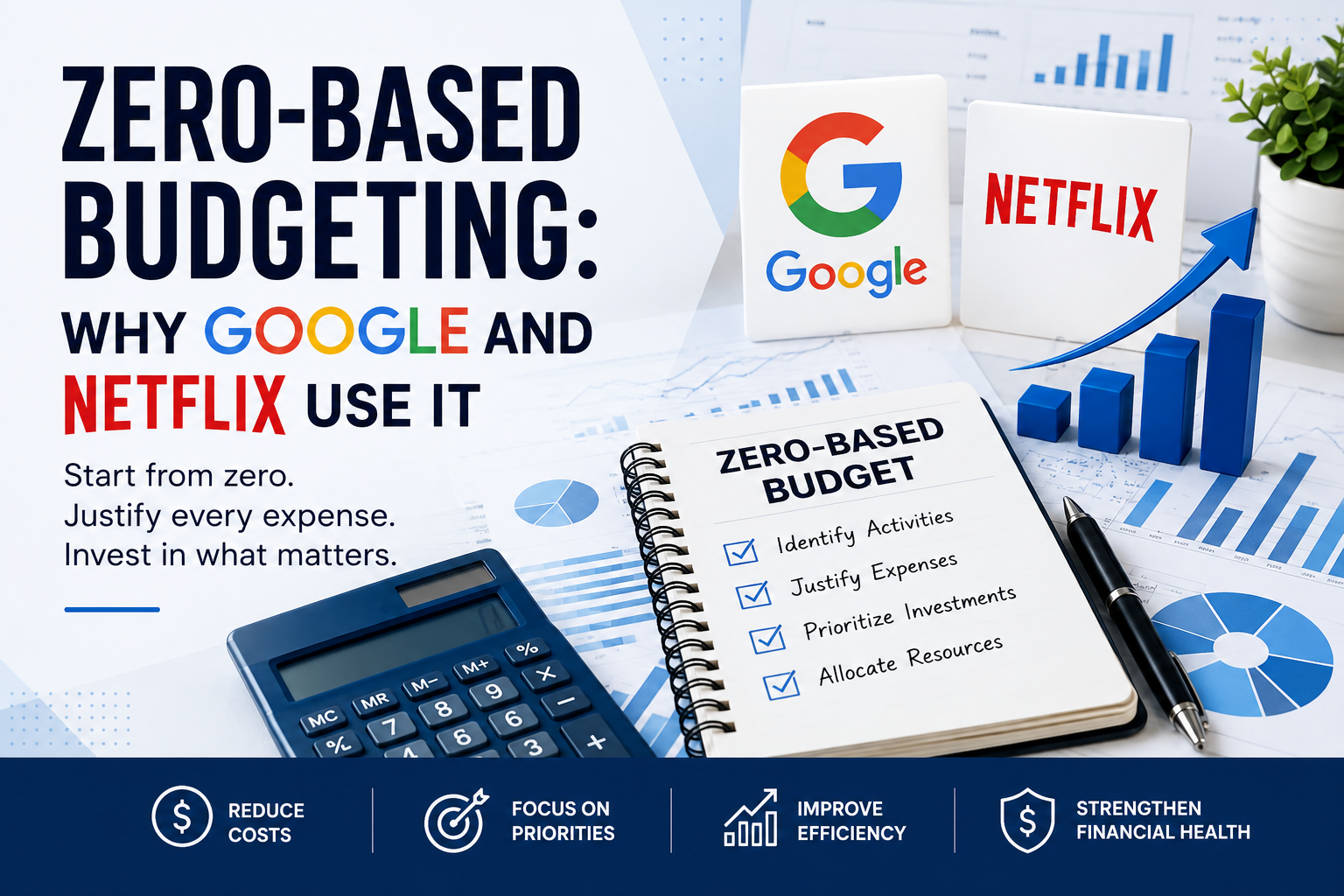
Rather than assuming every existing expense deserves continued funding, this budgeting approach requires every department to justify its budget from scratch during each budgeting cycle. This approach helps organizations eliminate unnecessary spending, improve cash flow, and allocate resources to initiatives that generate the highest value.
Companies such as Google and Netflix are widely recognized for their strong financial discipline and continuous evaluation of operational spending. Although they do not publicly disclose every detail of their budgeting processes, their emphasis on efficiency and strategic resource allocation reflects many of the core principles of Zero-Based Budgeting.
This article explains how Zero-Based Budgeting works, why it matters for finance teams, and how businesses can use it to improve financial performance.
What Is Zero-Based Budgeting?
Zero-Based Budgeting (ZBB) is a budgeting methodology where every budgeting period begins with a budget of zero.
Instead of carrying forward previous budgets, every expense must be reviewed and approved based on its current business value.
Unlike traditional budgeting, which assumes historical spending will continue, Zero-Based Budgeting asks a fundamental question:
“If we were starting the business today, would we still spend money on this?”
Only expenses that directly support business objectives receive funding.
This makes Zero-Based Budgeting one of the most effective strategies for improving financial discipline and operational efficiency.
Traditional Budgeting vs. Zero-Based Budgeting
Many organizations prepare budgets by increasing last year’s allocation by 5–10%.
While this method is simple, it often preserves unnecessary expenses.
| Traditional Budgeting | Zero-Based Budgeting |
|---|---|
| Starts with last year’s budget | Starts from zero |
| Automatic budget increases | Every expense requires approval |
| Historical spending influences future budgets | Current business needs determine spending |
| Hidden inefficiencies remain | Wasteful spending is identified quickly |
| Easier to prepare | Requires detailed financial analysis |
Finance leaders increasingly prefer Zero-Based Budgeting because it aligns spending with current priorities instead of outdated assumptions.
How Zero-Based Budgeting Works
A Zero-Based Budgeting process typically includes the following steps.
1. Start Every Budget at Zero
Every department begins with no allocated budget.
No expense is automatically approved simply because it existed last year.
2. Identify Essential Business Activities
Department managers list every activity required to achieve business goals.
Examples include:
- Marketing campaigns
- Employee salaries
- Software subscriptions
- Cloud infrastructure
- Vendor contracts
- Office operations
- Customer support
3. Justify Every Expense
Finance teams evaluate every budget request by asking questions such as:
- Is this expense necessary?
- What business value does it provide?
- Can the same outcome be achieved at a lower cost?
- What happens if this expense is removed?
This review ensures company resources are invested wisely.
4. Prioritize Investments
Once expenses are justified, leadership ranks them according to:
- Business impact
- Return on investment (ROI)
- Revenue generation
- Risk reduction
- Strategic importance
Funding is then allocated to the highest-priority initiatives.
Why Companies Like Google and Netflix Use Zero-Based Budgeting Principles
Technology companies operate in rapidly changing markets where priorities evolve constantly.
Instead of relying solely on historical budgets, organizations continuously evaluate where capital delivers the greatest return.
This philosophy closely aligns with Zero-Based Budgeting.
1. Better Cost Control
Every organization accumulates unnecessary expenses over time.
Examples include:
- Unused software licenses
- Duplicate SaaS subscriptions
- Low-performing marketing campaigns
- Legacy vendor contracts
Without regular reviews, these expenses remain in future budgets.
Zero-Based Budgeting forces finance teams to eliminate waste before budgets are approved.
2. Improved Resource Allocation
Innovation requires investment.
By reducing unnecessary operational expenses, organizations can redirect capital toward initiatives such as:
- Artificial intelligence
- Product development
- Cybersecurity
- Cloud infrastructure
- Customer experience
Instead of increasing every department’s budget equally, resources are invested where they generate the greatest business value.
3. Greater Financial Accountability
Every department becomes responsible for explaining how its spending contributes to organizational objectives.
This creates stronger collaboration between operational managers and finance teams while improving transparency throughout the budgeting process.
4. Increased Financial Agility
Business priorities change quickly.
Zero-Based Budgeting allows organizations to adjust spending based on:
- Economic conditions
- Market opportunities
- Customer demand
- Business strategy
Rather than waiting until the next fiscal year, companies can adapt budgets to changing circumstances.
How Zero-Based Budgeting Benefits Finance Teams
Zero-Based Budgeting is not just a management strategy—it is also a powerful financial planning tool.
Finance departments gain several advantages.
Better Expense Visibility
Every expenditure is documented and justified.
Finance teams gain a clearer understanding of where company money is being spent.
Improved Cash Flow Management
Reducing unnecessary spending leaves more working capital available for strategic investments.
This strengthens liquidity and improves long-term financial stability.
Organizations that consistently monitor spending are also better prepared for unexpected economic challenges.
More Accurate Financial Forecasting
Because budgets are based on current operational needs rather than historical assumptions, financial forecasts become more realistic.
This supports better planning for revenue, expenses, and future investments.
Stronger Budget Governance
Zero-Based Budgeting creates standardized approval processes that reduce unnecessary purchases and improve compliance with internal financial policies.
The Role of Accounts Payable in Zero-Based Budgeting
Accounts Payable (AP) data plays a critical role in successful Zero-Based Budgeting.
Finance teams rely on invoice histories, recurring payments, and vendor transactions to identify spending patterns and uncover unnecessary costs.
For example, AP teams can quickly identify:
- Duplicate vendor subscriptions
- Recurring software licenses that are no longer used
- Expensive supplier contracts that should be renegotiated
- Frequent low-value purchases that can be consolidated
When integrated with AP automation software, Zero-Based Budgeting becomes even more effective because finance leaders have access to real-time spending data instead of relying solely on historical reports. As AI continues to reshape Accounts Payable workflows, organizations can gain greater visibility into spending while reducing manual processing and operational costs.
Challenges of Zero-Based Budgeting
Although Zero-Based Budgeting offers significant benefits, implementation requires commitment.
Common challenges include:
Time-Intensive Reviews
Reviewing every expense requires more effort than traditional budgeting.
Organizations must dedicate sufficient time to budget preparation.
Cultural Resistance
Employees may be accustomed to receiving similar budgets every year.
Moving to Zero-Based Budgeting requires a shift toward greater financial accountability.
Data Quality
Poor financial records make it difficult to justify spending decisions.
Accurate accounting data and expense tracking are essential.
Leadership Commitment
Senior management must actively support the budgeting process and ensure consistent decision-making across departments.
Best Practices for Implementing Zero-Based Budgeting
Organizations can improve implementation by following these practices.
- Define clear business objectives before creating budgets.
- Use historical financial data to evaluate spending trends.
- Prioritize investments based on measurable business outcomes.
- Review recurring expenses regularly.
- Involve finance, procurement, and department managers in budget discussions.
- Monitor budgets throughout the year instead of reviewing them only annually.
- Use budgeting, accounting, and AP automation software to improve financial visibility.
Organizations looking to modernize their budgeting process can also explore insights from Harvard Business Review, which regularly publishes articles on financial management, budgeting strategies, and organizational performance.
Is Zero-Based Budgeting Right for Your Business?
Zero-Based Budgeting works particularly well for organizations that want to:
- Reduce operational costs
- Improve financial transparency
- Optimize cash flow
- Increase profitability
- Support strategic growth
- Eliminate unnecessary expenses
Although large enterprises often use Zero-Based Budgeting, small and medium-sized businesses can also benefit by applying its principles during annual financial planning.
Conclusion
Zero-Based Budgeting has become one of the most effective approaches to modern financial management. Instead of increasing last year’s budget by a fixed percentage, it requires organizations to evaluate every expense based on current business priorities.
For finance teams, this means greater visibility into spending, stronger cost control, improved cash flow, and more strategic resource allocation. Accounts Payable data, accurate financial reporting, and budgeting software further strengthen the effectiveness of Zero-Based Budgeting by providing the insights needed to make informed financial decisions.
While companies like Google and Netflix may not publicly describe their budgeting frameworks in detail, their disciplined approach to evaluating investments and controlling operational costs reflects many of the principles behind Zero-Based Budgeting. Businesses of all sizes can adopt these practices to build a leaner, more efficient, and financially resilient organization.