
The estimated reading time for this post is 403 seconds
Starting a U.S. business as a nonresident can give international entrepreneurs access to a large consumer market, established financial infrastructure, and global business networks. But forming a company in the United States involves more than filing a registration form.
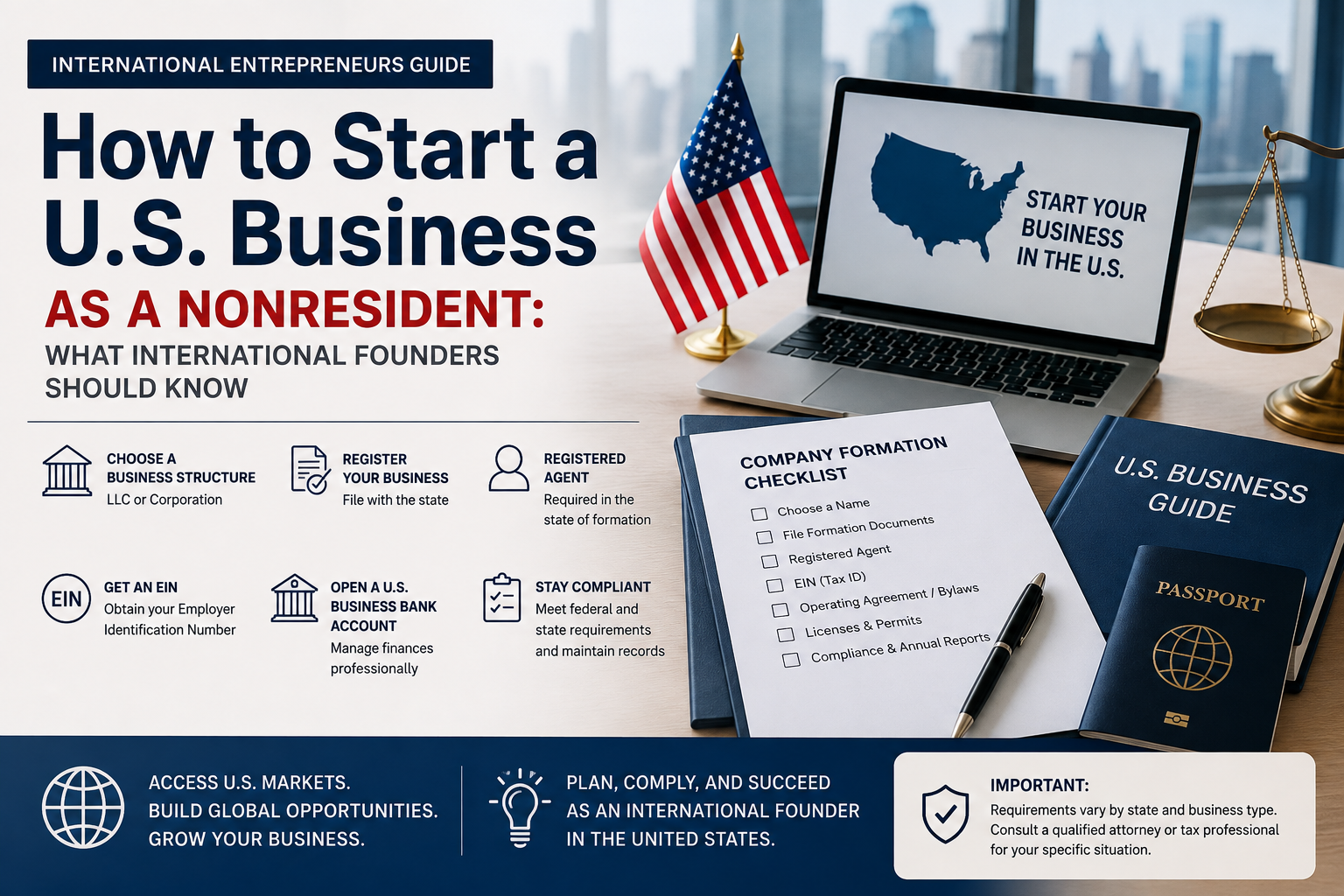
Nonresident founders may need to choose a business structure, register with a state, appoint a registered agent, obtain an Employer Identification Number (EIN), maintain company records, and understand ongoing federal and state requirements.
The process can also involve tax and immigration considerations that are separate from company formation. Understanding these responsibilities before creating a company can help international founders avoid unnecessary administrative problems. For founders planning a U.S. business, understanding these responsibilities early can also make the formation process more predictable and help reduce avoidable administrative costs.
Can a Nonresident Start a U.S. Business?
In many cases, U.S. citizenship or permanent residency is not required to establish a U.S. business entity. However, requirements can vary depending on the state, business structure, ownership, and activities of the company.
The U.S. Small Business Administration notes that registration requirements vary by state and business structure. Entrepreneurs may need to provide information about the business, ownership or management structure, and registered agent.
It is also important to separate business formation from immigration and tax issues.
Creating a U.S. company does not automatically give an individual the right to live or work in the United States. Likewise, forming a company does not automatically eliminate U.S. tax obligations.
The IRS states that nonresident aliens engaged, or considered engaged, in a U.S. trade or business may have U.S. filing and tax obligations.
1. Choose the Right Business Structure
Two common structures international entrepreneurs encounter are the Limited Liability Company (LLC) and the corporation.
An LLC can provide liability protection while offering flexibility in how the business is organized and taxed. A corporation is a separate legal entity and may be attractive to businesses that expect to raise capital or issue shares.
The SBA notes that the choice of structure can affect taxes, personal liability, fundraising, paperwork, and other requirements.
There is no universally best structure for every founder.
Before deciding, consider:
- Number of owners
- Tax treatment
- Liability considerations
- Expected outside investment
- Where the business will operate
- State filing requirements
- The founder’s home-country tax position
For complicated cross-border situations, professional legal or tax advice may be appropriate.
2. Select a State and Register the Company
Once the business structure is determined, the founder generally needs to choose a state of formation and prepare the required documents.
The process may include:
- Choosing a business name
- Selecting a state
- Preparing formation documents
- Providing registered-agent information
- Filing formation documents
- Creating an operating agreement or corporate bylaws
LLCs generally use articles of organization, while corporations typically use articles of incorporation. Requirements vary by jurisdiction.
Choosing a state based solely on the cheapest filing fee may not always be appropriate. Founders should consider where the company will operate and what ongoing obligations may apply.
3. Understand the EIN
An Employer Identification Number (EIN) is a federal tax identification number issued by the IRS.
Whether a nonresident founder needs an EIN, and how the application is handled, can depend on the circumstances of the business and the owner’s tax situation.
The IRS provides procedures for certain applicants outside the United States. Because requirements can vary, international founders should rely on current IRS guidance rather than assuming every nonresident business follows the same process.
4. Arrange a Registered Agent
A registered agent is another important part of establishing a formal business entity.
State requirements differ, but businesses generally need an appropriate point of contact for receiving official documents and government correspondence.
For a nonresident founder who does not maintain a physical presence in the United States, arranging registered-agent services can become an important administrative consideration.
5. Understand Ongoing Compliance
Company formation is only the beginning.
After registering a U.S. business, owners may need to monitor annual reports, state fees, tax filings, licenses, business records, and other compliance obligations.
The SBA advises businesses to remain compliant with applicable federal and state requirements.
Corporations can also have more extensive internal record-keeping responsibilities, while LLC requirements may be less formal depending on state law.
Missing a state deadline can create unnecessary administrative problems even when the company is otherwise operating normally.
6. Compare Business Formation Services
International entrepreneurs do not necessarily have to manage every formation task themselves.
Online business-formation providers can help organize certain administrative services, including state filing preparation, registered-agent services, document management, and compliance reminders.
These services are optional. A founder can also work directly with the relevant state authority or engage an attorney, accountant, or other professional.
For someone unfamiliar with the U.S. administrative system, a formation service may provide convenience by organizing several tasks through one platform.
7. A Look at Zenind
One provider operating in this market is Zenind.
According to information published by the company, Zenind offers LLC and corporation formation services in all 50 U.S. states and the District of Columbia. Its services also include registered-agent services, compliance support, and assistance related to EIN applications.
Zenind also states that it serves founders of different nationalities and provides information specifically addressing non-U.S. residents.
For international entrepreneurs, the potential advantage of a service like Zenind is primarily administrative. A centralized platform can help founders organize formation documents and related services instead of researching every requirement independently.
However, a formation provider does not replace individualized legal or tax advice. Founders remain responsible for understanding the obligations that apply to their businesses.
What Should Founders Compare?
Before choosing an online formation provider, entrepreneurs should look beyond the advertised starting price.
Important factors can include:
- State filing fees
- Registered-agent costs
- EIN assistance
- Annual compliance services
- Document preparation
- Customer support
- Business address options
- Government fees
- Renewal costs
- Optional versus required services
Government filing fees may be separate from the provider’s service fees. Zenind, for example, states that government fees are not included in its listed formation pricing.
What International Founders Should Consider
Before starting a U.S. business, international entrepreneurs should answer several basic questions.
Where should the company be formed? The cheapest filing fee is not necessarily the most appropriate option.
Which structure fits the business? LLCs and corporations can have different legal, tax, and operational implications.
What tax obligations could apply? Cross-border businesses can involve both U.S. and foreign tax considerations.
Does the business need an EIN? Founders should review current IRS requirements rather than relying solely on third-party guidance.
What ongoing filings are required? Formation does not eliminate annual or periodic compliance obligations.
How does the founder’s home country treat the business? International tax rules can affect the founder even when the business primarily operates in the United States.
Read more: Travel Insurance Is Easy to Ignore—Until One Unexpected Expense Changes the Trip
The Bottom Line
Starting a U.S. business as a nonresident can be achievable, but the process requires more planning than simply registering an LLC or corporation online.
International founders need to consider business structure, state registration, registered-agent requirements, EIN procedures, ongoing compliance, and potential tax obligations.
Online formation providers such as Zenind can make some administrative tasks more convenient, but they should be viewed as administrative tools rather than substitutes for individualized legal or tax advice.
The strongest approach is to understand the requirements first, compare formation options carefully, and seek professional advice when the business or tax situation is complex.
Sources
- Internal Revenue Service — Nonresident Aliens
IRS — Nonresident Aliens - Internal Revenue Service — Publication 515 (2026)
IRS — Publication 515: Withholding of Tax on Nonresident Aliens and Foreign Entities - Zenind — U.S. Company Formation Services
Zenind — U.S. Company Formation Services
Affiliate Disclosure: This article contains affiliate links. Federal Finance Journal may receive compensation if readers purchase services through those links, at no additional cost to the reader. Our editorial coverage and conclusions are independent of affiliate relationships.
This article is for informational purposes only and does not constitute legal, tax, immigration, or financial advice. Requirements can change and may vary by individual circumstances and jurisdiction.