The estimated reading time for this post is 346 seconds
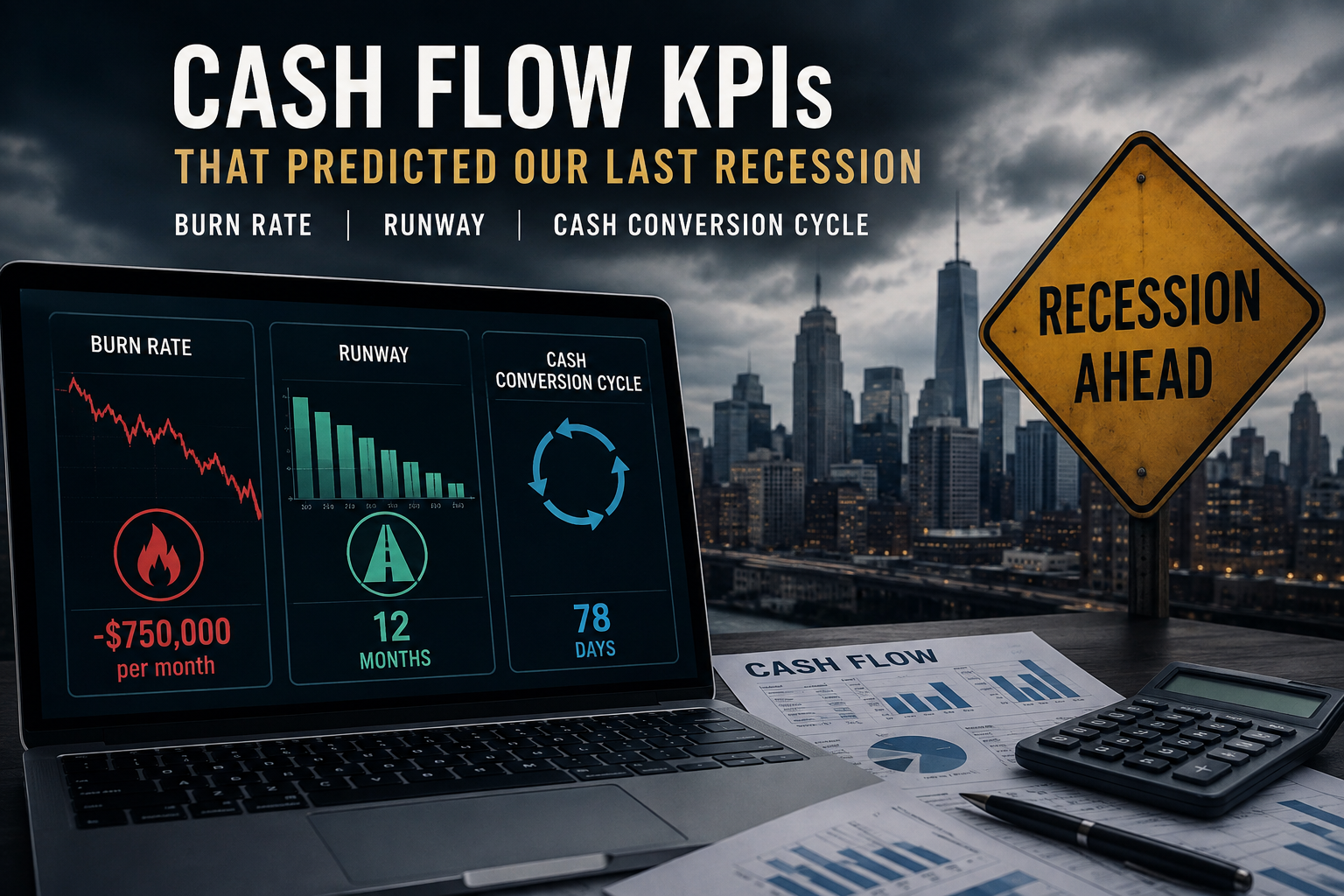
Many businesses don’t fail because they are unprofitable—they fail because they run out of cash. Before every economic downturn, warning signs often appear in financial statements months before headlines announce a recession. The businesses that survived the last recession weren’t necessarily the most profitable; they were the ones closely monitoring their cash flow KPIs.
As economists continue debating whether another slowdown is approaching, finance leaders are once again paying closer attention to liquidity rather than growth alone. Metrics such as burn rate, cash runway, and the cash conversion cycle (CCC) have become essential indicators of financial resilience.
In this article, we’ll explore the cash flow KPIs that historically signaled financial stress before the last recession and explain how companies can use these metrics today to prepare for uncertain economic conditions.
Why Cash Flow KPIs Matter More Than Profit During a Recession
Revenue can remain stable while cash quietly disappears.
Many businesses report accounting profits but still experience liquidity problems because cash is tied up in inventory, unpaid invoices, or excessive operating expenses.
During recessions, several things happen simultaneously:
- Customers delay payments.
- Inventory moves more slowly.
- Credit becomes more expensive.
- Banks tighten lending standards.
- Investors become cautious.
These conditions increase pressure on working capital, making cash flow management one of the most important responsibilities for finance teams.
Companies that monitor leading cash indicators can often identify financial risks several quarters before they appear in earnings reports.
1. Burn Rate: The First Warning Signal
Among the most important cash flow KPIs, burn rate measures how quickly a business spends cash
Originally popular among startups, burn rate has become an important metric for companies of all sizes because it reflects operational sustainability rather than accounting profitability.
A company with:
- High operating expenses
- Declining revenue
- Negative operating cash flow
will see its burn rate accelerate.
For example:
- Beginning cash: $8 million
- Ending cash after one month: $7.2 million
Monthly burn rate:
$800,000
If this trend continues while sales weaken, the company may eventually require external financing at unfavorable terms.
Before the 2008 financial crisis, many rapidly expanding businesses maintained aggressive hiring and spending despite slowing demand. Their burn rates increased months before broader economic indicators reflected the downturn.
Today, investors frequently evaluate burn rate alongside revenue growth to determine whether a company’s expansion is financially sustainable.
2. Cash Runway: How Long Can the Business Survive?
Cash runway is one of the most closely watched cash flow KPIs because it estimates how many months
The calculation is straightforward:
Cash Runway = Cash Balance ÷ Monthly Burn Rate
A business with:
- Cash reserves: $18 million
- Burn rate: $1.5 million per month
has approximately 12 months of runway.
Runway becomes increasingly important during periods of:
- Rising interest rates
- Reduced venture funding
- Slower consumer spending
- Economic uncertainty
During previous recessions, companies with more than 18 months of cash runway generally had greater flexibility to reduce costs strategically instead of making emergency decisions.
Finance executives increasingly view runway as a stress-testing tool rather than simply a startup metric.
3. Cash Conversion Cycle (CCC): The Hidden Predictor
The Cash Conversion Cycle (CCC) measures how long it takes a company to convert investments in inventory into actual cash received from customers.
The formula is:
CCC = Days Inventory Outstanding + Days Sales Outstanding − Days Payables Outstanding
A longer cash conversion cycle means money remains tied up in operations for extended periods.
This often happens when:
- Inventory accumulates.
- Customers delay payments.
- Suppliers require faster payment.
- Sales begin slowing.
Many manufacturers experienced rising CCCs before the last recession because inventory remained unsold while receivables continued growing.
A worsening cash conversion cycle frequently appears before declining earnings, making it one of the most valuable early warning indicators available to finance professionals.
Why These KPIs Predicted the Last Recession
Historical downturns demonstrate that liquidity stress develops gradually.
Companies rarely fail overnight.
Instead, warning signs often emerge in sequence:
Rising Burn Rate
Operating expenses continue climbing despite slower revenue growth.
Shortening Cash Runway
Cash reserves shrink while financing options become more expensive.
Expanding Cash Conversion Cycle
Working capital becomes trapped in inventory and unpaid invoices.
Together, these indicators reveal deteriorating financial flexibility well before layoffs or bankruptcies occur.
Businesses that ignored these trends often reacted too late.
Historical financial data published through the U.S. Census Bureau’s Quarterly Financial Reports has consistently shown that weakening liquidity and rising working capital pressures tend to emerge before broader economic slowdowns become evident.
Industries Most Sensitive to Cash Flow KPIs
Although every business should monitor liquidity, some sectors are particularly vulnerable.
Retail
Retailers frequently experience inventory build-up before economic slowdowns.
An increasing CCC often signals weakening consumer demand.
Manufacturing
Manufacturers face longer production cycles, making inventory management critical.
Delayed customer payments can rapidly increase financing requirements.
Construction
Construction companies typically operate with lengthy payment schedules.
Even profitable projects can create severe cash shortages if receivables remain outstanding.
Technology Startups
Fast-growing startups often prioritize expansion over profitability.
Monitoring burn rate and runway helps determine whether growth remains financially sustainable.
How Finance Leaders Use These Metrics Today
Modern finance teams rely on dashboards that update cash metrics in real time instead of waiting for monthly reports.
Leading organizations typically monitor:
- Weekly operating cash flow
- Burn rate trends
- Cash runway scenarios
- Accounts receivable aging
- Inventory turnover
- Cash conversion cycle
- Working capital ratios
Rather than focusing solely on quarterly earnings, CFOs increasingly emphasize liquidity planning under multiple economic scenarios.
Companies that integrate these KPIs into forecasting models can identify operational problems earlier and respond more effectively.
Warning Signs Businesses Should Never Ignore
Several red flags deserve immediate attention:
- Operating cash flow turns negative despite positive net income.
- Burn rate accelerates for multiple consecutive months.
- Cash runway falls below one year without a financing plan.
- Accounts receivable continue increasing faster than revenue.
- Inventory turnover slows significantly.
- Cash conversion cycle expands quarter after quarter.
Individually, these issues may appear manageable.
Together, they often signal deteriorating financial health.
Preparing for the Next Downturn
No KPI can predict recessions with perfect accuracy.
However, cash flow indicators consistently provide earlier warnings than many traditional profitability measures.
Companies can strengthen resilience by:
- Maintaining adequate liquidity reserves.
- Reducing unnecessary operating expenses.
- Improving invoice collection processes.
- Optimizing inventory management.
- Regularly stress-testing cash forecasts.
- Monitoring liquidity metrics alongside revenue growth.
Businesses that prioritize cash discipline are generally better positioned to navigate economic uncertainty without resorting to emergency financing or severe cost-cutting measures.
Final Thoughts
Economic downturns rarely arrive without warning.
Long before headlines announce slowing growth, a company’s financial statements often reveal subtle signs of stress. Rising burn rates, shrinking cash runway, and expanding cash conversion cycles have historically preceded periods of economic weakness because they reflect a business’s ability to generate and preserve liquidity.
For finance leaders, investors, and business owners, monitoring these KPIs is not simply an accounting exercise—it’s an essential part of risk management. Organizations that recognize these warning signs early can make informed decisions, protect cash reserves, and remain financially resilient even as market conditions deteriorate.